What were the April Fools’ trends in 2021? Four ideas that caught a PR planner’s attention

Hello, everyone!
And it has been a while. This is Kameyama, a planner at SUNNY SIDE UP.
At the end of last year, we looked at the Buzzword Awards from a PR planner’s perspective,
What were the “real trends” of 2020? The Buzzword Awards through the eyes of a PR planner at SUNNY SIDE UP!https://blog.ssu.co.jp/pr_methods/18548/
This time, I would like to take a look at corporate April Fools’ ideas for 2021!
First, here are some April Fools’ ideas from 2021!
Let’s jump right in and highlight a few examples.
❶ Made-to-order giant Tirol Chocolate now available!?
Just imagine how happy you’d be if Tirol Chocolate were gigantic…
/
BIG NEWS🗣️✨
\Announcement: made-to-order giant Tirol Chocolate😍🤎
We’ll share the reservation page today at 12:00😋✨
#AprilFools pic.twitter.com/QQLyLduf1j
— Tirol Chocolate (@TIROL_jp) March 31, 2021
(Source: Twitter: Tirol Chocolate @TIROL_jp)
This is a cute April Fools’ idea that captures a desire everyone has had: wanting to buy in bulk as a kid and eat as much Tirol Chocolate as you can until you are full.
❷ New Sapporo Potato flavors launching!?
A new lineup joins #SapporoPotato!
🌟#EdoPotato Extra Veggie
🌟#NahaPotato Okinawan Purple Sweet Potato Flavor
🌟#OsakaPotato Takoyaki Flavor
makes a grand debut🎉✨Which one would you like to try❓
Tell us in the comments☺✎#AprilFools pic.twitter.com/Q3yz8oF4EF— Sapporo Potato Official (@CalbeeSapporoCP) March 31, 2021
(Source: Twitter: Sapporo Potato Official @CalbeeSapporoCP)
They presented three new flavors as an April Fools’ idea. Because the flavors felt plausible, I suspect they may have even planned to actually release the one that got the most reactions later on. April Fools’ ideas are often funnier when they are obviously unrealistic, but this one was an April Fools’ concept that made you anticipate a second-stage rollout.
❸ A diffuser that smells like Toriki goes on sale!?
Believe it or not!!
We have released a diffuser that smells like Toriki!!
It would be amazing to enjoy the Toriki scent at home too, right?・∨・
With this, I could easily have three beers!🍺🍺🍺#AprilFools #NotTrueAtAll #Torikizoku #Toriki #Tricky pic.twitter.com/JtRf90R9C9— Torikizoku Tricky (@_torikizoku) April 1, 2021
(Source: Twitter: Torikizoku Tricky @_torikizoku)
A diffuser that lets you enjoy the izakaya Torikizoku scent at home (the sweet-and-savory aroma of yakitori)—a delight for Toriki fans!? Compared with ❷, this was a more obviously fake April Fools’ idea.
❹ A whole lineup of animal-themed April Fools’ ideas!!
Announcing the new label “Yadotent+”🎊
Using darkroom technology to block over 90% of sunlight! Sleep soundly without drying out, even in midsummer.Developer comment: “We wanted to deliver a comfortable home to hermit crabs who love the outdoors. That wish has finally come true. This is a confident product that leverages our technology.” #AprilFools pic.twitter.com/0pOQAfdofX
— Coleman Japan (Official) (@Coleman_Japan) April 1, 2021
(Source: Twitter: Coleman Japan (Official) @Coleman_Japan)
Daihatsu launches the new kei car “Mira Guinea Pig.”
Based on the concept of “making guinea pigs for everyone,”
it delivers even greater safety and peace of mind with the evolved Smart Guinea Pig III package.
With its new-sensation style, “Mira Guinea Pig” fits seamlessly into your life.#AprilFools pic.twitter.com/Ls3bwfiMYS— Hello! Daihatsu [Official Daihatsu Motor] (@HelloDaihatsu) April 1, 2021
(Source: Twitter: Hello! Daihatsu [Official Daihatsu Motor] @HelloDaihatsu)
/
New release on April 1!
FUNS Luxury Fabric Softener “Silver Vine Scent”
\A fabric softener for cats, made by cat lovers for cat lovers, with plenty of high-quality silver vine extract🐱
With this, you are guaranteed to be popular with cats👕🐈💕#AprilFools #Cats #WantToConnectWithCatLovers pic.twitter.com/k7Lx2ALqH2— Daiichi Soap Co., Ltd. [Official] (@daiichisekken) March 31, 2021
(Source: Twitter: Daiichi Soap Co., Ltd. [Official] @daiichisekken)
/
Mount RAINYAA now on sale!😻✨
\I am the cat CEO! I have taken over Mount RAINIER, meow!
The “Cat Package” is now on sale, meow😺
If you support “Mount RAINYAA,” RT this, meow😼We will keep developing café lattes that soothe everyone even more, meow~🐾 #AprilFools #SayingSomethingYouCantTellIsTrueOrNot pic.twitter.com/yhVK2jDpt2
— Mount RAINIER (Mt.RAINIER) (@mtrainier_jp) March 31, 2021
(Source: Twitter: Mount RAINIER (Mt.RAINIER) @mtrainier_jp)
[Breaking]
A new product to lift your spirits, too:
“Cat Sandwich” is here!🍞🐱🍞*For display only; not edible
Sales may be suspended depending on the cat’s moodDetails on the Cat Sandwich here!https://t.co/Oe93LM3sSQ#AprilFools#SubwaysCatSandwich pic.twitter.com/kpLKL3sB4b
— Subway (@subwayjp) March 31, 2021
(Source: Twitter: Subway @subwayjp)
Even as a joke, animals are a powerful way to create something soothing. With just a quick search, you can see how many companies did animal-related campaigns. Rather than feeling disappointed when you realize it is a joke, the cuteness of the animals stands out, leaving you with a warm feeling—so I believe it is a safe April Fools’ approach with a lower risk of backlash.
By the way, this is not an April Fools’ idea, but our company once even had a “dog” become president…
2018 was the Year of the Dog! A new company founded by “dogs” only—“Sunnyside Dog” established!?
https://blog.ssu.co.jp/blog/13669/
Have corporate April Fools’ posts become more subdued!?
In recent years, it seems that corporate April Fools’ posts have decreased.
As an advertising medium that can reach many people in a single day, newspaper ads are particularly powerful. Among them, the five major national newspapers (Asahi Shimbun, Yomiuri Shimbun, Mainichi Shimbun, Sankei Shimbun, and The Nikkei) tend to draw attention due to their large readership. Within newspaper advertising, full-page (15-tier) and double-page (30-tier) placements allow for full-bleed expression and impactful messaging. However, this year, we did not see any April Fools’ ads in the five major papers using the 15- or 30-tier sizes.
In digital advertising, there is also an ad menu that appears as the first view for one day in Twitter’s search field (displayed at the very top of the Search tab), but that was not an April Fools’ idea either.
There are two factors behind this.
The first is that “the brand exists in consumers’ minds.”
The second is “corporate backlash on social media.”
I would like to explain these two factors.
Brands can no longer be created!!
In the past, information did not circulate nearly as widely as it does today. This change is due to the spread of the internet and smartphones. To illustrate how much the volume of information has increased: global data traffic, which was 17 GB per month in 1984, grew to 122 exabytes (122 billion GB) in 2017—about 7 billion times more. Furthermore, it was projected to increase to 278 exabytes per month in 2021, 2.3 times the 2017 level, with internet communication technology and IoT driving this growth. (Source: “Cisco Visual Networking Index Global IP Traffic Forecast, 2016-2021” (Cisco))
You may be wondering what this change in information volume has to do with brands. In fact, it is deeply related. People’s information-processing capacity has also grown in step with the volume of information, but compared with the increase in information, it is still negligible. Modern people can no longer process all the information circulating in the world, and inevitably must be selective.
That is why, in the past—when there was less information and markets were not yet commoditized—company-originated information (i.e., advertising) was accepted. As long as advertising provided information consumers needed, even forced-exposure formats like TV commercials and newspaper ads were not treated as “villains” the way they often are today. In that environment, company-originated information was everything to consumers when it came to brands, and brand image could be created through corporate messaging.
In contrast, today, because the volume of information has exploded, company-originated information such as advertising tends to be treated as a “villain” (of course, content that can be enjoyed is accepted, but for modern people busy processing information, ad space is basically seen as a villain = an annoyance).
In addition, if you search online, you can find the information you want; if you look at review sites and social media, you can obtain real, firsthand information. As a result, even if companies pay to run ads, consumer-originated information on social media is seen as more authentic and valued, and advertising messages are often ignored.
As a result, brand image cannot be created through corporate messaging; instead, it is cultivated in consumers’ minds based on the information they obtain through various touchpoints.
Brands are no longer something that can be created—they are entrusted to consumers.
Social media backlash cases have increased!!
It has been some time since social media began to spread, and it has become a communication infrastructure. When social media first emerged, it was a tool for enjoying communication between individuals, but it also came to be used as a communication tool between individuals and companies. And whereas social media was mainly used among acquaintances, it also became a tool for easily communicating with complete strangers who share common hobbies and interests.
As the number of users and usage scenarios expanded, social media drew more attention from the public and the media as an information source, and it increasingly became a catalyst that ignites information spread.
At the same time, gaps between company-originated advertising (messages, visions, etc.) and reality, as well as companies’ behind-the-scenes realities, began to be shared publicly. As a result, transparency and sincerity in corporate activities came to be strongly demanded.
Even if marketing and PR departments understand these realities, not all employees do—and as a result, social-media-driven corporate backlash cases never ceased.
There are other factors behind backlash as well, including the democratization of information and the diversification of values.
As mentioned earlier, because consumer-originated information is valued more, consumers have become information-empowered. And as consumers collectively broadcast and support a single claim on social media, a track record has accumulated of changing society and companies. Information came to be handled equally not only by companies and governments, but also by consumers. This is the democratization of information.
Technological innovations such as the spread of the internet have made it possible to communicate with overseas countries that were once geographically distant, leading to the globalization of ideas and values. Overseas values were accepted in Japan, spread through social media, and Japan’s traditional fixed notions and biases began to be criticized. Companies and brands that cling to outdated values are more likely to become flashpoints, making it important to embrace the diversification of values.
It has become harder for companies to take on April Fools’…
With “the brand exists in consumers’ minds” and “corporate backlash on social media,” even if a company goes all-in on April Fools’, it is not only difficult to cultivate a positive brand image—the risk of triggering backlash can feel greater. As a result, companies have found it harder to take on April Fools’.
Newspapers are a “serious medium” where credibility is emphasized, so they are not a natural fit for April Fools’. In contrast, Twitter has a unique culture of sharing funny things and making them even funnier together, so it is highly compatible with April Fools’.
As a platform where posting from an official corporate account does not require media spend, Twitter is easier to experiment with than newspaper ads—and the standout April Fools’ ideas in 2021 were on Twitter.
Do companies even need to do April Fools’ ideas in the first place?
In that context, do companies really need to share April Fools’ ideas? With corporate-originated information being harder to trust and playful corporate posts carrying backlash risk, I believe there are two benefits.
The first is strengthening brand image. Companies and products whose brand image is already seen as “fun,” “approachable,” “bright,” or “humorous” have a foundation that makes this kind of playful messaging easier to accept—and it can further reinforce their brand image.
Personally, I think snacks, toys, and game apps are relatively easy categories for this.
The second is creating content for communications. When there is no new product or service news to share, PR agencies use terms like “media hook” or “PR hook,” and develop information that can lead to publicity by offering new angles and perspectives.
Information such as novelty (first in Japan) or exclusivity (limited to U29) is often seen in TV and web media articles because it captures people’s interest. April Fools’ is one type of media hook—specifically, “seasonality.” If the information fits the April Fools’ context, it becomes valuable precisely because it is April 1. And because it may be reported or discussed together with other April Fools’ topics, this “seasonality” is an important element in creating content for communications.
Going forward, I would also like to explain media hooks. By the way, we have also explained information development in this article by another member!
“What is ‘information development’ in PR—creating ‘valuable information’?”
https://blog.ssu.co.jp/pr_methods/18287/
With these two elements, it is a great opportunity for companies and product brands to share information—and it is an occasion we hope you will make full use of.
Finally, here is an introduction to an interesting April Fools’ idea from 2021!
PR TIMES: “April 1. Turn April Fool into April Dream.”
PR TIMES, a press release distribution service, ran a newspaper ad in The Nikkei on April 1 using the creative below.
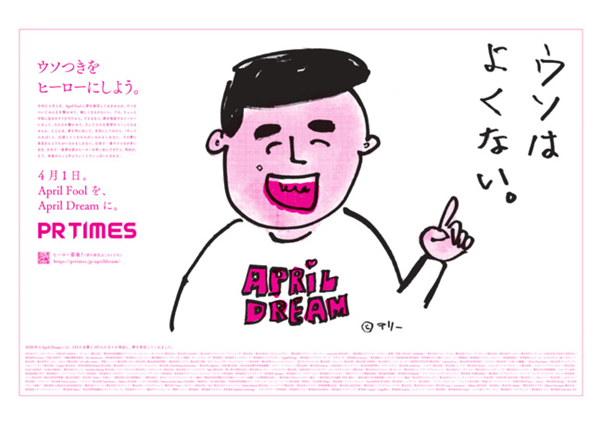
(Image source: PR TIMES)
The tagline is “Let’s make liars into heroes.” I thought it was exceptionally well done. The sound of “Fool” and “Dream” is pleasing, but beyond that, I feel it is copy that properly reflects the mood of our times in terms of meaning as well. A dream is a future goal that has not yet been realized, but if it is not achieved, it can be dismissed as nonsense—or worse, you may be labeled a liar. Even so, the message is that PR TIMES, as a press release distribution service, supports and empowers people and companies who speak their dreams—and it is clearly connected to their own service.
At a time when it has become harder for companies to share information through April Fools’ ideas, I thought it was a very strong perspective to propose a concept that makes you want to share something on April Fools’ in the exact opposite, serious direction.
In closing…
At SUNNY SIDE UP, we support PR activities on a retainer basis for clients across a wide range of industries. In doing so, there are many times when clients struggle to find topics to share, but based on our experience, we have developed information from every possible angle.
If you are facing similar challenges—such as those in corporate advertising or PR departments—please feel free to contact us.
Thank you very much for reading this article through to the end. See you in the next article, or in an actual project!