What Are the “Real Trends” of 2020? Buzzwords Awards Through the Eyes of a PR Planner at SUNNY SIDE UP

Hello, everyone!
I’m Kazuyuki Kameyama, a planner at SUNNY SIDE UP. As the title suggests, in this article I will share what I felt about the 2020 Buzzwords Awards from a PR planner’s perspective.

Image source: U-CAN New Words and Buzzwords Awards website
https://www.jiyu.co.jp/singo/
What are the year-end Buzzwords Awards?
The official name of the year-end tradition known as the “Buzzwords Awards” is the “2020 U-CAN New Words and Buzzwords Awards.” It is an award that selects new words and buzzwords that attracted widespread attention throughout the year, and also honors the individuals and organizations deeply involved with those “words.”
The awards began in 1984. U-CAN started sponsoring them in 2003, and in 2004 the awards were renamed to their current title.
Because the sponsor’s name is included in the award title, the sponsor’s name is also featured every time the awards are covered in media such as TV and the web, making the advertising and promotional impact extremely significant.
This year’s Buzzwords Awards are filled with COVID-related terms
I have broadly categorized this year’s Buzzwords Awards into three genres: “COVID-related,” “entertainment,” and “other.”
[COVID-related: 19 terms]
“Crash Landing on You / 4th Korean Wave Boom,” “New Lifestyle / New Normal,” “Abenomask,” “Amabie,” “Uber Eats,” “Essential workers,” “At-home time / Stay home,” “Online ○○,” “Cluster,” “Go To Campaign,” “3Cs (three types of ‘close’),” “Self-restraint police,” “Zoom-ready,” “Comprehensive, bird’s-eye,” “Social distance,” “Solo camping,” “Telework / Workcation,” “Close contact,” “PCR test”
[Entertainment-related: 8 terms]
“Atsumori,” “Funny faces / Paying back a favor,” “Demon Slayer: Kimetsu no Yaiba,” “Perfume,” “Let’s turn back time (Pekopa),” “NiziU,” “Fuwa-chan,” “Well, yeah~ (Boru Juku)”
[Other: 3 terms]
“Beyond AI,” “Kagopaku,” “BLM (Black Lives Matter) movement”
Source:https://www.jiyu.co.jp/singo/
There are 19 COVID-related terms. Even in advertising and PR, we often disseminate information using messages and contexts aligned with the times and trends, so we frequently attached COVID-related topics. This is because doing so makes it easier to attract interest and empathy from both the media and consumers, and to create social momentum.
Regarding this kind of “PR story building,”thisarticle also covers it, so please be sure to read it as well.
The relationship between the Buzzwords Awards and today’s media landscape
Looking back at past buzzwords, nominations for entertainment-related terms and TV-originated phrases have gradually decreased. In the advertising industry, the only notable example is the line “Now!” from a TOSHIN High School TV commercial, which won the grand prize in 2013.
I believe the decline in entertainment-related nominations is due to factors such as the spread of the internet and smartphones, the fragmentation of media, and the diversification of values.
As a result, it has become harder for universally known “must-trends” to emerge as in the past, and instead “in-cluster trends” within groups that share the same values and interests have begun to proliferate.
However, while TV ratings and newspaper and magazine readership have generally declined, that does not mean everything has shifted entirely to web media.
❶ People’s values and needs have diversified
❷ Niche media have increased to meet those diversified needs
❸ Media touchpoints have become multi-device due to smartphones
❹ Offline media have become web media (services)
Because of ❶–❹, real-time reach for any single medium has become dispersed.
With the spread of the internet and smartphones, most media content can now be viewed anytime, anywhere. People might learn about a TV drama on Twitter or watch compilation videos on YouTube, for example.
One of this year’s nominees is “Crash Landing on You / 4th Korean Wave Boom,” and I believe this is because “in-cluster trends” occurred across various segments and ultimately grew into a must-trend.
To elevate content or events into a must-trend, it is necessary to build a story (pathway) that generates buzz, and publicity across multiple media (and the spread of the topic to social media) is key.
To begin with, TV/VOD dramas deliver video content in a continuous series at set times, so even if viewers have limited literacy or comprehension, it is easier to sustain ongoing buzz.
Compared with magazine or web serials, video content is more emotionally compelling than text alone, which generates empathy and excitement and leads to many posts on social media (in the case of TV, there is also “SNS posting time” during commercials).
Around the end of 2019, the Korean film “Parasite” won the top prize at the Cannes Film Festival and was released and drew attention in Japan, raising Japanese expectations for Korean video works. At that time, Netflix released “Crash Landing on You” and “Itaewon Class.” Then, during the distribution period, COVID led to requests to refrain from going out, and Korean VOD dramas became a leading example of high-quality content that could be enjoyed at home. For Japanese viewers, overseas works distributed via VOD became “the best entertainment content to enjoy at home,” replacing Japanese TV programs that could not film enough at the time to release new works.
With these other hits and the social backdrop overlapping, the shows became a topic across various clusters such as “movie lovers,” “drama lovers,” and “K-drama lovers,” and as a result were covered by many media outlets and grew into a must-trend.
Even in PR work, if you design a buzz-generating story based on an understanding of the current state of the media and society, it is possible to grow into a must-trend and win the Buzzwords Awards. However, that is extremely difficult…
Top 3 PR “long-drive” ideas selected by an SSU planner that achieved distance even against the headwinds of the COVID era!
From here, with your kind indulgence, I would like to introduce three PR ideas that I personally found interesting even within the context of the COVID era.(I had just played my first round of golf in 2020 the other day, so I will be presenting this with a subtitle like this…)
Buzz-Generating Long-Drive Contest, No. 3: Pantene “#Heya We Go” Project

Image source: “#HeyaWeGo” website
https://pantene.jp/ja-jp/hair-we-go/heyawego
Since 2018, Pantene has been running a campaign called “#Hair We Go—Let’s go with this hair,” designed to encourage people to think about each individual’s unique hair characteristics.
Amid the COVID era, when people were asked to refrain from going out and were spending more time at home in late April, they shared messages and content to help people spend their time at home a little more brightly and positively.
The content was.“hair care and hair arrangement methods for people frustrated that they could not go to the salon,” which is something consumers needed, but above all, the cleverness of the project name stood out.
The adaptation from the original “Hair We Go” to “Heya We Go” to match the COVID situation is excellent and memorable. Even now, this project often comes up in planning meetings, and I truly think it is a brilliant idea.
Buzz-Generating Long-Drive Contest, No. 2: Pocari Sweat’s new CM series “NEO Chorus”
https://www.youtube.com/watch?v=hCoxujrzPaw&feature=emb_title
https://www.otsuka.co.jp/adv/poc/tvcm202004_02.html
In recent years, Pocari Sweat has developed commercials around the theme of teenage youth, and the release date of the first installment of this new CM coincided with the time in April when COVID was spreading and a state of emergency was declared.
At that time, there was an overwhelming “self-restraint mood,” and corporate communication was difficult. However, the new copy was: “Turn thirst into strength.” I was impressed by how well it captured both Pocari Sweat’s product characteristics and the social climate.
They also abruptly changed the plan from having 500 people gather in one place to sing in a chorus—an expression of the very “crowding” that was being prohibited—to a concept that compiled and edited students’ selfie videos into a single piece.
The catchphrase and visuals were the best possible expression of empathy that could be created at the time, and even I—someone who did not have a sparkling youth in my student days—was moved. I am sure those who watched the CM or YouTube videos were touched, and while it is an advertising and video production approach, I felt this was an idea with PR thinking behind it.
Buzz-Generating Long-Drive Contest, No. 1: “Essential workers”
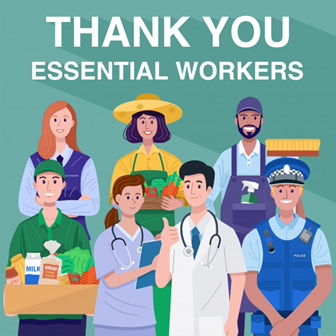
This term, which was also nominated for the Buzzwords Awards, felt like a term—and an idea—rooted in PR thinking. During the COVID era, when the world was flooded with keywords and negative behavior born from restrictions, “essential workers” was a very positive term.
“Essential” means “fundamental” or “indispensable,” and the term “essential workers” refers to people in occupations that cannot stop operating even during the COVID era—those who must work to support people’s daily lives.
Normally, they are the “unsung heroes,” so to speak—jobs that support what we take for granted and are not easily put in the spotlight. By shining a light on them, society paid attention, and it became easier for companies to offer support and for people to express gratitude.
I do not know who first coined the term “essential workers,” but if it was created with the intention of supporting people in those occupations, I thought they must be an excellent copywriter and someone with strong PR thinking.
In PR, there is a technique of creating an atmosphere of “buzz” and “attention” by compiling related information about what you want covered and distributing it to the media.
If the term and concept of “essential workers” were created to collectively highlight occupations such as healthcare workers and supermarket staff and to encourage support and gratitude from society as a whole, I felt it was a wonderful idea (honestly, I am just jealous).
That concludes the Top 3 PR “long-drive” ideas that Kameyama selected at his own discretion—PR ideas that became a topic even during COVID!
In PR, it is enough to win buzzwords within your target audience!
Up to this point, I have written about how something becomes a must-trend, but in PR, becoming a must-trend is not the only goal.
It is now rare for a company’s brand or service target to be truly mass, and in many cases it is enough to generate buzz within the intended target and create an in-cluster trend. As mentioned earlier, with the diversification of values and the saturation of services, companies and products themselves have also been forced to present a USP (Unique Selling Proposition) through niche characteristics.
In strategic PR communication planning, it is necessary to select media and design a buzz-generating story in line with segmented targets. Of course, it is best if you can grow it into a must-trend, but the cost-effectiveness of spending the budget required to get there is questionable.
Precisely because we live in an era of rapid change, rather than aiming for a “big must-trend far in the distance,” let us first set “near-term in-cluster trends” as the goal and steadily do what we can. As those efforts accumulate, they may develop into a must-trend.
I have written at length about the Buzzwords Awards and PR, but to everyone who read to the end, thank you very much. At SUNNY SIDE UP, we have a proven track record of creating “fun commotion” across a wide range of industries, so please feel free to contact us.https://www.ssu.co.jp/contact/
The next buzzword may already be being born right beside you.
Author:
SUNNY SIDE UP Account Planning Department, Planner
Kazuyuki Kameyama
It has been two years since I joined SUNNY SIDE UP mid-career to develop my planning skills. I am from the same generation born in 1992 as former Nogizaka46 member Mai Shiraishi and host Roland, but these days I feel anxious that I have not been able to make as much of an impact on the world as they have. My number-one favorite is Mei Higashimura from Hinatazaka46. Everyone, please support Mei-Mei.