A Guide to Effective Media Exposure: “Media Promotion”—A Taste of SUNNY SIDE UP’s Step-by-Step PR! Vol. 4
Hello! I’m Oku, in charge of this series.
I want to bring information to the media, but I don’t know how!
I don’t know how to start media promotion!
Some PR beginners and solo PR professionals may be struggling with these concerns.
From Chapter 4 of this book—a somewhat “controversial” work (laughs) that reveals the full extent of SUNNY SIDE UP’s accumulated media promotion expertise—we present excerpts for those who want to learn media outreach.
■ Introduction
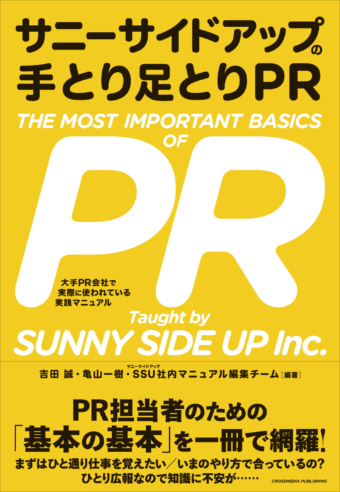
This article is part of a series that excerpts content from SUNNY SIDE UP’s Step-by-Step PR, a manual published in May 2021 for PR beginners and solo PR professionals.
Previous articles can be found here ▼
A Taste of SUNNY SIDE UP’s Step-by-Step PR!
If this article makes you want to learn more or have a copy on your desk, we would be delighted if you purchase it at bookstores or on Amazon.
Purchase on Amazon here.
If you have questions about the book or would like more detailed information, please feel free to click the “CONTACT button” (bottom right on PC, bottom on mobile)!
Now, let’s dive into the content!
■ The Basics of “Media Promotion” for Efficient Exposure
This chapter explains the key points for promoting developed information to the media.
The most important thing to keep in mind when approaching the media is “achieving good exposure.” Good exposure brings about changes in customer awareness and behavior, benefits both your company and the media, and creates a WIN-WIN-WIN relationship.
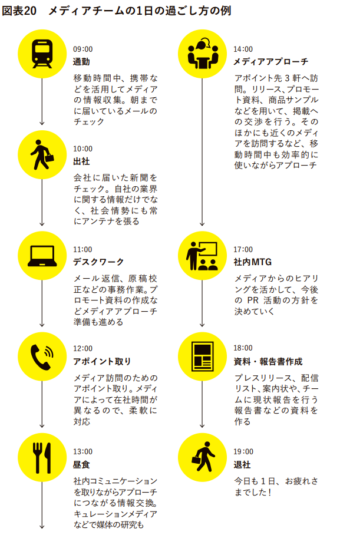
To achieve this, it is essential that exposure leads to the next development. Even if exposure is difficult to obtain, do not be discouraged—continue to take action while making daily improvements and considerations 〈Figure 20〉.
■ Ideal Media Promotion Structure
If a team building media relations has three members, and each member contacts three media representatives per day, that amounts to 45 people per week. With approximately 50 working weeks per year, the team can contact a total of 2,250 media representatives annually.
When team members have specialized expertise or unique media connections, sharing information within the team ensures that all members can access the latest media information at any time. This enables efficient promotion and leads to successful exposure.
■ From Creating Media Lists to Achieving Exposure
The basic workflow consists of: ① continuously updating media lists and management, ② creating and distributing press releases, ③ maintaining daily media outreach, and ④ achieving exposure.
① Creating and Managing Media Lists
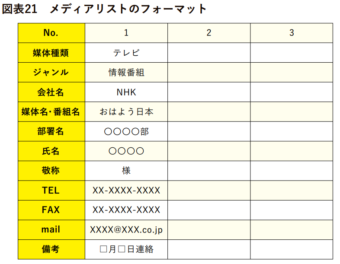
Using accumulated media data, media websites, and resources such as the PR Handbook, create a comprehensive list of target media where you want exposure and media with potential for coverage.
Information about contacts is also very important. Knowing which day of the week they handle which segment, their work schedule, their affiliation and position (station staff, production company, AD, director, writer, desk, etc.), and even the industries, fields, and companies they are currently interested in makes outreach easier.
Record contact history with representatives, such as when you called or met. Also understand the media’s planning decision periods, meeting and deadline dates, and schedules for holidays such as Obon and New Year.
② Creating and Distributing Press Releases
Create press releases to avoid missing exposure opportunities. Set distribution dates and times with media work schedules in mind. Calculate backward from article creation schedules to secure the necessary number of days, and set distribution times when media can easily check and you can follow up immediately after distribution.
While TV stations, newspapers, and news agencies may specify fax delivery, email has become the mainstream distribution method, and an increasing number of media outlets have discontinued fax and only accept email. For email distribution, aim for attachments of 3 MB and 3–5 images.
When distributing via fax to “press clubs”—organizations created by major media to cover and report on government agencies and other public institutions—advance registration is often required, as these clubs are typically located within government buildings, prefectural offices, or chambers of commerce.
There are also PR services that distribute releases online. In addition to distributing to media, they can publish your release on media outlets with guaranteed placement. Since reporters receive mountains of releases daily, craft your subject line carefully to encourage them to open it.
For example: “[○○ Company: AI-Powered New Service] New Product Launch on ○/○! ×× Now Possible.” Include the company name, date, what the information is about, and concisely state who should read it.
|
One More Thing! Distribution Text May Be Used As-Is Some online media may use the expressions in your distribution text directly in their articles, so it is important to use language that does not compromise your brand image. |
▼ Distribution Text Tips
◉ Keep decorative elements to a minimum. Limit lines to approximately 40 full-width characters
◉ Include a self-introduction of the sender at the beginning
◉ Explain the lead concisely using the “5W1H”
◉ Leave space between paragraphs for readability
◉ Use fonts, bold, underlines, and colors to convey brand image
◉ Ensure consistent use of either polite or plain style
◉ Extract only noteworthy content from the release as a summary
▼ Attachments
◉ Attach press releases as PDF files to emails. PDFs should allow text to be copied
◉ Use Google Drive or Dropbox for multiple images
Note that using shortened URLs increases the risk of being filtered as spam
◉ A few images can be inserted directly into the email body
③ Media Outreach
Identify contacts persistently and systematically.
Every reporter you meet becomes an important relationship. Interview contacts about their schedules, meeting timings, and planned features, and create materials that further break down press releases or compile information for feature articles.
④ Achieving Exposure
Immediately check published articles for errors. Analyzing which parts of the press release were used provides material for improving future releases.
Thanking reporters, asking about the factors behind the coverage, and inquiring about post-publication reactions—maintaining contact with reporters after publication leads to future opportunities.
■ Conclusion
Now that you have learned the basics of media promotion, it’s time to put them into practice!
The rest of the book is packed with SUNNY SIDE UP’s accumulated media promotion tips, including approach points for various media such as TV and web, key points to confirm when communicating with media contacts, and useful techniques.
If this taste isn’t enough, please check out the full book here and aim for even better exposure!