Survey PR reveals how attitudes have changed after Tokyo 2020! — The Nippon Foundation conducts a survey on diversity & inclusion | SDGs Series, Vol. 1
Hello everyone! This is Sugimoto from the Sports Division 3.
We are pleased to bring you the first installment of the SDGs series by the SDGs PR Strategy Team!
Click here for Vol. 0.
SDGs Series Vol. 0: Can we change the world with a “fun commotion”? Introducing the social-good initiatives led by SUNNY SIDE UP GROUP!
2021 is coming to an end soon. As the “Kanji of the Year” was recently decided to be “gold,” the biggest event of the year was likely the Tokyo 2020 Olympic and Paralympic Games. Many of you probably cheered on the athletes, got excited by the opening ceremony production, and enjoyed watching the events on TV at home.
After experiencing the Tokyo Games, how have our attitudes changed? In September this year, The Nippon Foundation conducted an “Awareness Survey on Diversity & Inclusion.” Since The Nippon Foundation had conducted the same survey in 2019, it compared the results from two years ago with those from this year to examine how Japanese society and individuals’ awareness of diversity has changed, and released the findings in a news release.
This approach—conducting a survey to generate buzz—is known as survey PR. At SUNNY SIDE UP, we supported the planning and design of this survey and handled the PR. As interest in the SDGs and momentum for social initiatives continue to grow, how are Japanese society and each individual’s awareness changing today? In this article, we will introduce some of the survey results.
*Diversity & inclusion refers to initiatives that respect diversity and promote inclusion (embracing and leveraging differing values and abilities) to drive innovation and create new value, aiming for a society in which each person can thrive and find a place where they belong (hereafter referred to as D&I).
■ Awareness of D&I increased from about 30% before the Tokyo Games to about 40%
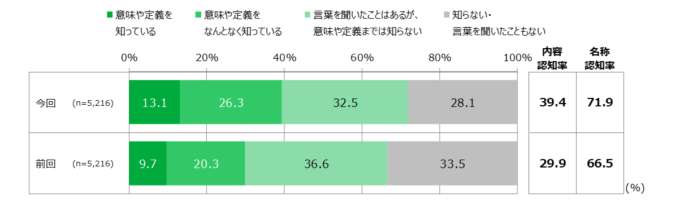
Regarding “diversity & inclusion,” 71.9% of respondents said they recognize the term—an increase of 5.4 points from 66.5% two years ago. In addition, the share of people who know its meaning and definition rose by 9.5 points, from about 30% (29.9%) in the survey two years ago to about 40% (39.4%) in this survey. This indicates that social awareness of D&I is spreading and understanding is deepening.
■ Prejudice and discrimination against social minorities decreased by 10 points after the Tokyo Games

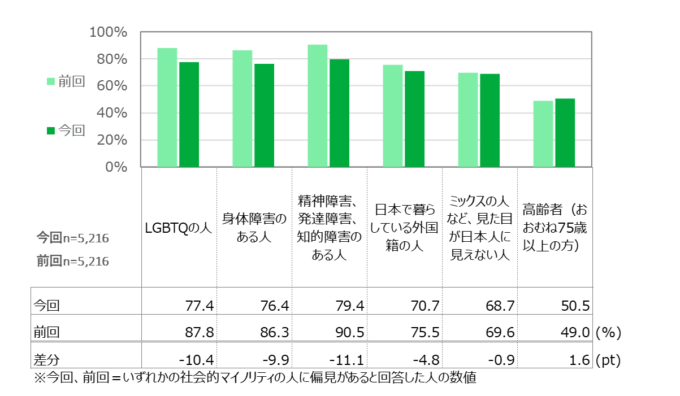
In response to the question of whether there is prejudice or discrimination against social minorities, 85.9% answered “I think there is prejudice or discrimination.” While still high, this was a 10-point decrease compared with 95.9% before the Tokyo Games.
However, a closer look shows that while the figure decreased by 10.4 points for “LGBTQ (lesbian, gay, bisexual, transgender, questioning/queer),” by 9.9 points for “people with physical disabilities,” and by 11.1 points for “people with mental disabilities, developmental disabilities, or intellectual disabilities,” there was no major change for “foreign nationals living in Japan,” “people who do not appear to be Japanese,” and “older adults.” The current situation suggests that awareness of prejudice and discrimination toward social minorities cannot necessarily be said to be decreasing overall. This difference may be due to factors such as increased opportunities to engage with people with disabilities through the Paralympics and greater awareness of LGBTQ issues.
*In this survey, “social minorities” refers to LGBTQ (lesbian, gay, bisexual, transgender, questioning/queer) people; people with physical disabilities; people with mental disabilities, developmental disabilities, or intellectual disabilities; foreign nationals living in Japan; people who do not appear to be Japanese, such as mixed-race individuals; and older adults (generally aged 75 and over).
■ About 60% of teens said “awareness of D&I has increased,” compared with about 30% among people in their 50s
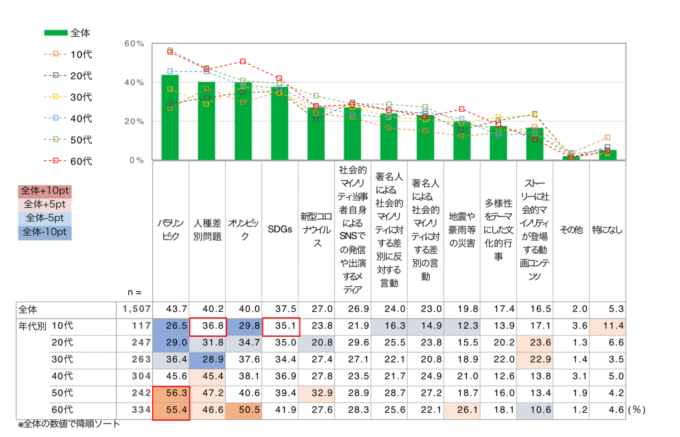
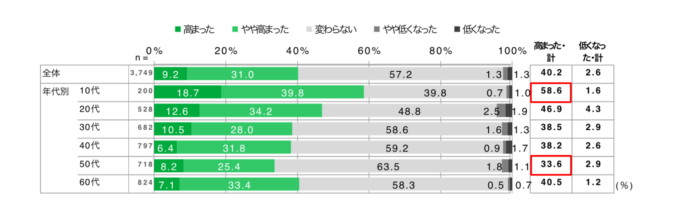
Increased awareness of D&I tended to be higher among teens and people in their 20s. Overall, the most common trigger for heightened awareness of D&I was the “Paralympics.” It is likely that exposure to the achievements of people with disabilities through the Paralympics led to changes in awareness.
However, when viewed by age group, respondents who cited the “Paralympics” and the “Olympics” as triggers were more common among those in their 50s and older, while teens were more likely to cite “racial discrimination issues (Black Lives Matter)” and the “SDGs.”
These differences by age group may be influenced by factors such as the media people engage with daily and school education. To deepen understanding and promote D&I, it appears that disseminating information and messages that reach a wide range of generations will be necessary.
By conducting a survey in this way, it is also possible to make social conditions—previously not visible—explicit in the form of numbers.
By visualizing the hard-to-put-into-words “mood of the times” through survey PR, an even larger movement can emerge. If you have decided on a theme but are unsure how to approach PR, considering this type of PR method is one option.
Finally, The Nippon Foundation commented on the survey results as follows:
“To advance awareness and understanding of D&I across society as a whole and eliminate attitudes of prejudice and discrimination toward social minorities, more long-term initiatives that involve people of different generations and regions are necessary. Specifically, it will be important to create more opportunities, in various forms, for contact with social minorities, and to further enhance education in schools on diversity and social minorities.”
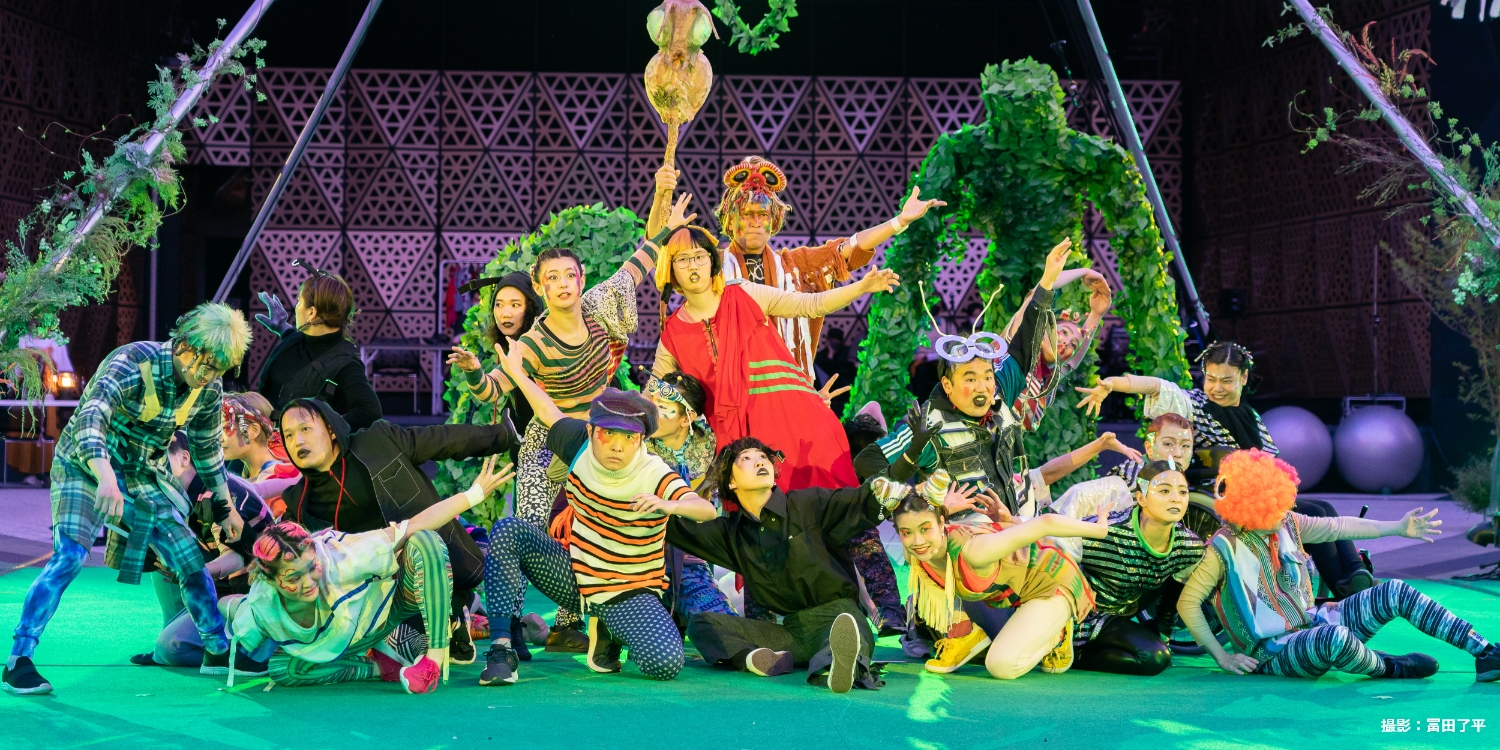
To eliminate attitudes of prejudice and discrimination toward social minorities, The Nippon Foundation has been holding the True Colors Festival since 2019—an arts festival enjoyed together with people of diverse individuality through performing arts, including differences in disability, gender, generation, language, and nationality. There is a wide range of content, so please be sure to check it out.
Official website: https://truecolorsfestival.com/jp/
Click here for an article introducing the True Colors Festival.
“Super Diversity”! What is this project that embraces and celebrates every individuality—disability, gender, nationality, and more?