Exploring the “Circular Economy” Through Japanese Materials in Omotesando: An Inside Report on the hide k 1896 Composite Textile Exhibition 2021!

Hello! I’m Mizutani, in my second year with the Sports division of the Public Relations Business Headquarters, Bureau 3!
To start off, what kind of “materials” do you like?
Crisp nylon, soft silk, or perhaps warm knits for the current chilly season? Of course, it is not just clothing; our surroundings are filled with items born from various materials, whether hard or soft, such as bags, furniture, tableware, and remote controls.
For instance, I am currently sitting on a wooden chair, drinking water from a glass cup, and typing on a plastic keyboard while facing a PC screen on a concrete table (laughs).
Have you ever thought about what happens to the materials that make up these items once you are finished using them?
“Items that can be taken apart are sorted, then everything is crushed into small pieces, and finally, they are probably either burned or buried…!?”
Even when I tried to imagine it, that was the extent of my understanding.
In recent years, terms like “recycling” and “sustainability” have appeared frequently in the media, and eco-friendly fashion items made from recycled materials are being sold. It feels as though various industries have finally begun to embrace recycling. Awareness of recycling is gradually increasing among both the companies that manufacture products and the consumers who purchase them.
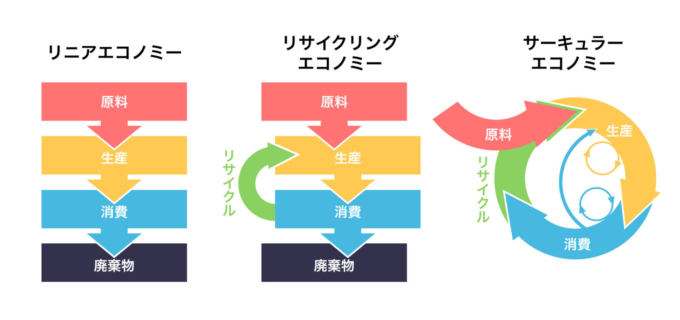
Image source: From the Trans Co., Ltd. website
While it feels as though recycling has finally become a part of our lives, the world is now turning its attention to the “Circular Economy”—a concept that goes beyond recycling to aim for “zero waste.” This approach not only promotes the efficiency of resource circulation but also operates on the premise of not creating waste or pollution from the product design stage. If a circular economy is realized, we can expect materials from existing products to be circulated and reborn into different products. In the Netherlands, the government has set a goal to transition to a fully circular economy by 2050. This is a concept that will undoubtedly become essential for future economic activities.
In this article, we introduce the “hide k 1896 Composite Textile Exhibition 2021,” an exhibition that invites visitors to touch these “materials” while reflecting on the realization of a Japanese-born circular economy and our sustainable future. We will report on the venue from the perspective of a SUNNY SIDE UP member who was in charge of the exhibition’s PR.
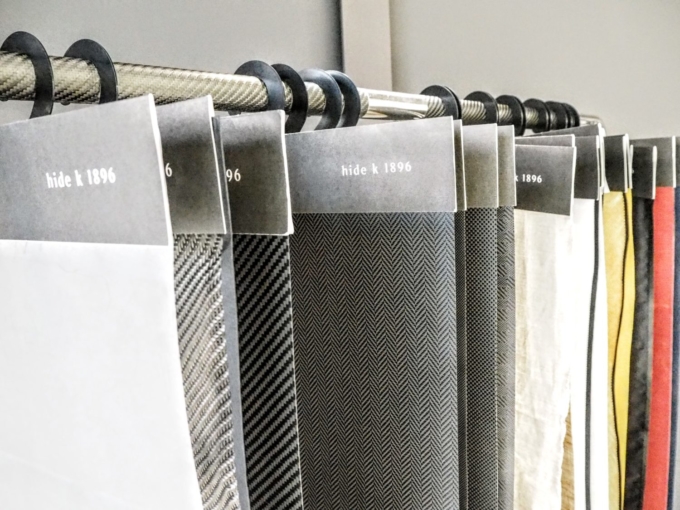
The hide kasuga group has its roots in “Kasuga Shoten,” a hemp wholesaler founded in 1896 near Zenko-ji Temple, one of Nagano City’s leading tourist attractions. Based on the concept of “Creation and Regeneration of Value,” the group has been working on the research and development of new materials designed for material recycling, with consideration for the environment and resources.
After years of research, the hide kasuga group developed “Composite Textile,” a soft material created by combining thermoplastic resins with artificial fibers such as carbon fiber or natural fibers such as hemp, cotton, and silk.

The defining characteristic of this material is that, despite being an artificial material, it can be returned to nature. Although it is a composite of natural and artificial elements, thermoplastic resin softens again when heated to its melting point, allowing the fibers and resin to be completely separated and recycled. Furthermore, it is resistant to scratches and water, lightweight, and can be sewn, making it suitable for use in a wide variety of products.
The gallery displays small electric vehicles (EVs) and furniture made using this unique “Composite Textile.”

The “GCH Tension Small EV,” designed by Kota Nezu—who also worked on the family robot LOVOT—features a tent structure that utilizes the non-stretch properties of Composite Textile as tension.
While the majority is made of carbon Composite Textile, the ceiling uses glass Composite Textile to allow warm sunlight to enter, and the seats use hemp Composite Textile to take advantage of the fabric’s texture.
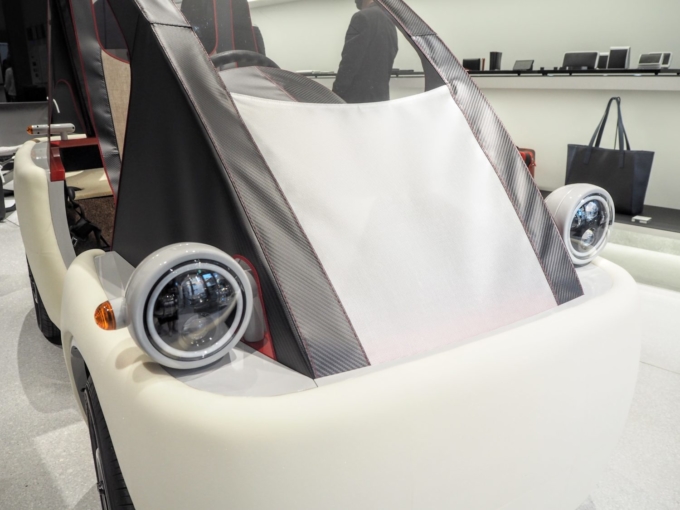
The bumper area uses polyurethane foam as-is, giving it a soft impression that blends into the city and its people. It has a compact design for one person, and the round headlights look like adorable eyes—it’s very cute!
At a media preview held prior to the exhibition, Mr. Nezu remarked, “As society and towns change, I thought it would be wonderful to see scenes where cars drive slowly through quiet streets, or children sit and play on soft cars parked by the roadside. By changing the materials used to build cars, I want to make vehicles a familiar presence loved by both people and the community.”
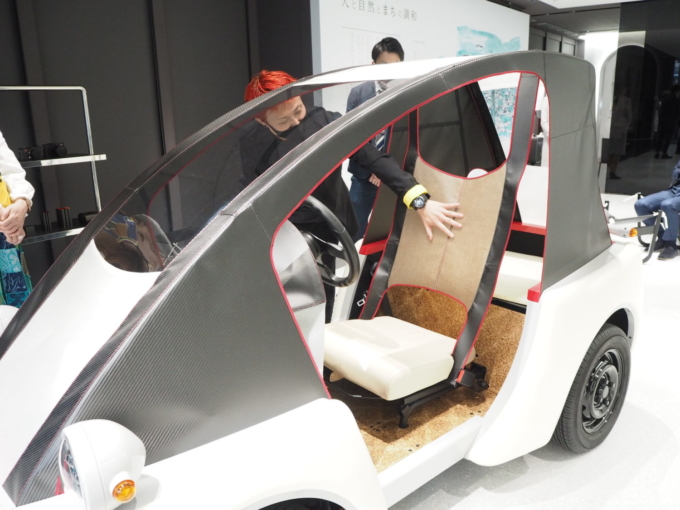


The new sensation of a ride that feels open yet secure and comfortable brought a wide smile to our member’s face (laughs).
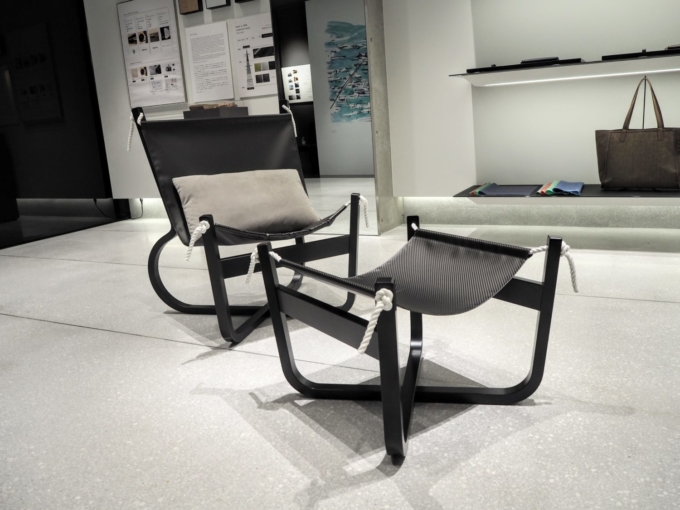
The “GCH Tension” lounge chair and ottoman, designed by product designer Keita Shimizu, utilize the different properties of Composite Textile and wood to provide a soft, enveloping seating experience. Braided cords are used for the joints instead of metal fittings, expressing a sense of Japanese aesthetics.
Furthermore, the gallery features the first public unveiling of “green zenkoji,” a wall art piece by architect Kengo Kuma, depicting a future town based on the theme of harmony between people, nature, and the city.

The precious sketches by Mr. Kuma, who is also well-known for designing the National Stadium visible from our office, were incredibly sophisticated and beautiful.
Additionally, at the exhibition venue “gallery de kasuga,” visitors can handle small items such as wallets, card cases, and bags made of “Composite Textile,” as well as collaborative products with brands like Lexus and Hotel Okura.
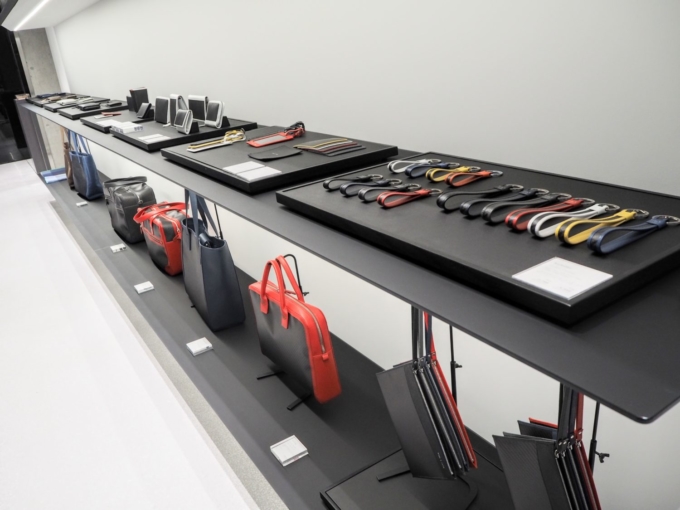
I hope to become the kind of sophisticated woman who can stylishly use such wonderful items! I truly admire the lifestyle of having high-quality, environmentally friendly items tucked away in one’s pocket for everyday use.
With terms like “Composite Textile,” “Circular Economy,” and “Thermoplastic Resin,” I initially thought this exhibition would require a high level of technical understanding. However, I was genuinely captivated by the warm atmosphere of the gallery and the stylish items, which softened the sense of obligation or formality often associated with environmental issues.
In 2020, the material think tank “hide kasuga 1896” launched the “Green Composite Hills by hide k 1896,” a circular economy consortium involving industry, academia, and government in collaboration with Mitsui Chemicals, Inc., Shinshu University Faculty of Textile Science and Technology, Nagano City, and Ichihara City. By focusing on “materials,” which are the starting point of manufacturing, we should keep an eye on their future initiatives aimed at realizing a Japanese-born circular economy and embedding environmental awareness into the daily lives of consumers.
The exhibition is being held until Saturday, December 25th, at the multi-purpose commercial facility “gallery de kasuga” in Omotesando.
https://www.gallerydekasuga.com/ja/news_events/1863/
*Tuesday to Friday by email appointment only; no appointment necessary on Saturdays. Closed Sundays and Mondays.
If you happen to visit Omotesando while it is sparkling with winter illuminations, please be sure to stop by!