Do you understand the difference between advertising and PR (public relations)? The minimum you need to know for communication planning.

Introduction
Hello to everyone who reads the SUNNY DAYS blog—it has been a while. My name is Kameyama, and I work as a planner at SUNNY SIDE UP.
Today, I would like to discuss the “difference between advertising and PR (public relations).”
| However, at SUNNY SIDE UP, we have traditionally viewed PR (public relations)—as mentioned later in this article—as a concept on the same level as marketing. This is PR in the broader sense, but in this article I am writing to help PR beginners deepen their understanding of PR in the narrower sense (i.e., public relations/publicity). |
That was a bit of preface, but from my perspective as someone who has experience with both advertising agencies and PR firms, this is not about concluding which is superior.
Both advertising and PR (i.e., publicity) are simply marketing methods. I hope this will serve as a reference when you plan by understanding each one’s characteristics—whether one is better suited to solving the issue at hand, or how to effectively coordinate the two from an overall, holistic perspective.
A basic comparison of advertising and PR (public relations)
Let us review the basics—likely covered by media outlets run by any PR firm.
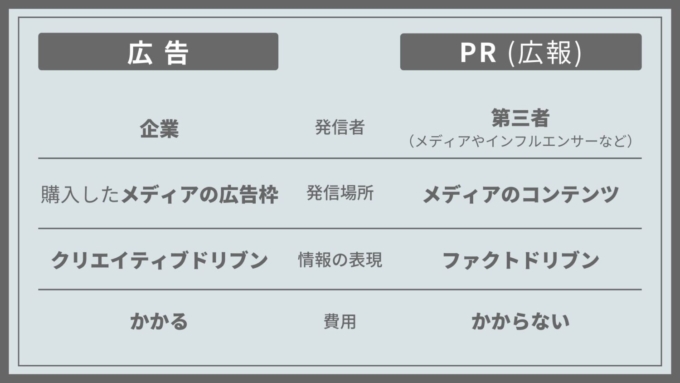
Advertising
• The company is the sender of the information
⇒ As a result, it may come across as strongly “company (advertising)”-driven.
• Communicate by purchasing ad space in media
⇒ In principle, as long as you can buy the space, the company is given a certain degree of discretion over the message to be communicated.
• Information can be expressed in a creative-driven way
⇒ Setting aside excessive expressions, you can generally express things freely as long as they pass ad review.
• Purchasing ad space costs money
⇒ In return, you can reliably disseminate information.
PR (public relations)
• A third party (media, influencers, etc.) is the sender of the information
⇒ It is less likely to be ignored by people who dislike advertising.
• Communicate within regular media content
⇒ If it does not align with the media’s features or the genres/themes it typically covers, it will not be picked up. Whether to share the information and how to edit it is left to the media.
• Information is built in a fact-driven way
⇒ If there is any falsehood in the information a media outlet covers, it undermines the outlet’s credibility. Therefore, you must be careful about whether claims can be stated objectively and whether they are properly substantiated.
• No cost is incurred because the media disseminates information voluntarily
⇒ However, if you use a PR firm, you will incur fees for its work (planning fees, labor costs, etc.).
Even when using the same media to disseminate information, differences in approach change how it is received and the impression it creates.
What advertising and PR (public relations) do best
Advertising excels at reliable reach and immediacy compared with PR. Each channel has its own characteristics; for example, web and social media ads are also strong because they allow segmented targeting.
I highlight this strength because, in PR, you need relationships with the media, and it is difficult to secure coverage unless there is a reason for the media to report on or cover what the company wants to communicate at that time.
In addition, if sudden changes in the social climate or unexpected events occur, even planned exposure on TV news programs may be canceled—so from that perspective, advertising is very strong.
On the other hand, PR’s strength lies in the credibility of the information. As noted earlier, information that feels strongly company-driven tends to be ignored. These days, consumers are quick to sense whether something is an ad, and some people dislike advertorials or social media posts labeled “#PR.”
With PR, however, if the media determines the information is worth reporting or publishing, it will communicate it in its own tone and manner. For viewers and readers, it comes from a trusted source, so it is readily accepted.

Can you use advertising and PR (public relations) appropriately?
Based on the above, I believe you can understand that this is not a simple binary choice of advertising vs. PR, and that it is also possible for each to complement the other’s strengths and weaknesses.
Because PR can be executed on a low budget and does not deliver immediate results, it tends to be deprioritized in corporate marketing activities. However, it is important to assess whether what you want to communicate has high news value (i.e., has a media hook—explained in more detail in this article). If it does, the key is whether you can build a strategy such as “designing with PR first as an effective communication method.”
In fact, it feels as though recent initiatives assume, as a prerequisite, that they have a media hook. And even when news value is not high, finding a way is one reason PR firms are involved. They can also serve as a consultation partner even when you cannot judge whether the news value is high.
Do you have someone on your team who understands how to change the message and story depending on whether you take an advertising approach or a PR approach?
In advertising, you use straightforward expressions so what you want to convey is clearly communicated; in PR, you use expressions that make media and influencers want to jump in. Or you use expressions that combine both.
If your team is not confident in that communication design, please feel free to contact SUNNY SIDE UP. If you reach out via the inquiry button at the bottom right of the page, the person in charge will get back to you.
Finally, PR (public relations) is one of the management functions…
Last year, something became a hot topic among those engaged in PR: an updated definition of public relations, which stated that public relations is one of the management functions, and it drew significant attention.
[Definition of Public Relations]
A management function in which an organization or individual builds and maintains socially desirable relationships through two-way communication with diverse stakeholders in order to achieve objectives and solve issues.
Reference:https://www.jsccs.jp/concept/
Then, as we entered 2024, it became a topic again: the definition of marketing was also updated, and its content is almost the same as the definition of public relations.
[Definition of Marketing]
(Marketing is) a concept and process for realizing a richer and more sustainable society by creating value together with customers and society, widely disseminating that value, and fostering relationships with stakeholders.
Note 1) The主体 is not limited to companies; individuals and nonprofit organizations, etc., may also be included.
Note 2) Fostering relationships also includes processes for creating new value.
Note 3) The concept implies initiative and includes strategies, mechanisms, and activities.
Reference:https://www.jma2-jp.org/home/news/916-marketing
Indeed, when you look at the updated definitions, they are similar. In this article, within marketing—specifically among communication methods that correspond to Promotion in the so-called 4P analysis—I explained the difference between advertising and PR (i.e., public relations/publicity), which can be easy to confuse. Neither advertising nor PR is an end in itself; both are merely means. I hope this article will help you understand their respective characteristics and differences within corporate marketing activities and support you in designing the optimal communication strategy.