Will People Move Without a Story? How to Create a PR Story

Hello! I am Y, a planner at SUNNY SIDE UP. In this installment of our “PR Lecture” series, I will discuss how to create a PR story.
Click here for the previous SSU PR Method article, “Part 2: What is Information Development in PR? Creating Valuable Information.”
PR: An Era That Demands Stories
For products or services with “obvious innovation,” highlighting their appeal can serve as a compelling reason for purchase. However, in today’s world, such products and services are rare.
In such cases, a “PR story” becomes essential for differentiation from competitors. By differentiating through storytelling, it is crucial to build resonance with consumers and provide them with a reason to buy. I will delve deeper into this topic in a future post.
PR Stories Are Rooted in Social Relevance
While we have discussed social relevance in previous posts, it remains indispensable to PR storytelling. This is because the very purpose of PR is to build relationships between products and social issues.
A PR story articulates a product’s position and its relationship to current social trends.
PR Story Basics: Following or Challenging the Trend
There are two primary patterns for demonstrating a product’s position within society: “Following the Trend” and “Challenging the Trend.”
■ Following the Trend
Creating a story that aligns with current social events or trends. This approach makes it easier to generate buzz by tapping into major public conversations and popular categories.
【Pros】
・A baseline level of topicality is guaranteed since many people and media outlets are already interested. (It is even more effective if presented as an evolution of the trend rather than just following it.)
【Cons】
・Achieving explosive popularity can be difficult due to competitors or products that have already secured a position. (There is a risk of being perceived as a “me-too” product.)
■ Challenging the Trend
Creating a story that takes a position contrary to current social events or trends. By positioning against the mainstream, it has the potential to generate buzz as a unique or novel perspective.
【Pros】
・If it successfully taps into latent needs, it has the potential to become a major sensation.
【Cons】
・By going against the mainstream (manifest needs), there is a risk of failing to resonate with the audience (falling flat).
Examples of “Following” and “Challenging” the Trend
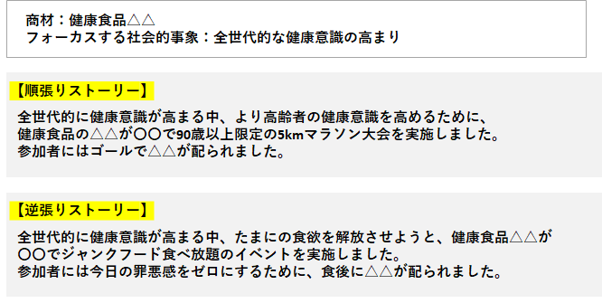
As shown above, PR stories are created by either aligning with social events (“Following the Trend”) or presenting an opposing view (“Challenging the Trend”).
By understanding this concept, you can generate at least two PR stories and content ideas for every social event. If you are a PR professional struggling with story creation, please give this a try!
At SUNNY SIDE UP, we leverage our high level of media literacy to constantly stay updated on newsworthy social events and craft compelling PR stories.
In the next installment, I will discuss the key PR points that should be prioritized in this day and age.
Stay tuned!
|
<PR Method Article List> Part 1: Why PR is Crucial Now—How SUNNY SIDE UP Defines PR |