Commemorating the Publication of “How to Create a Buzz That Turns Heads” – Revival Serial Column: The President’s Blog Not Written by the President
Part 1: Before the Buzz Began
Hello. This is Rory. It’s been a while.
It’s been so long that I’m sure everyone has forgotten this column even existed, but why am I brazenly reviving it now as a serial?
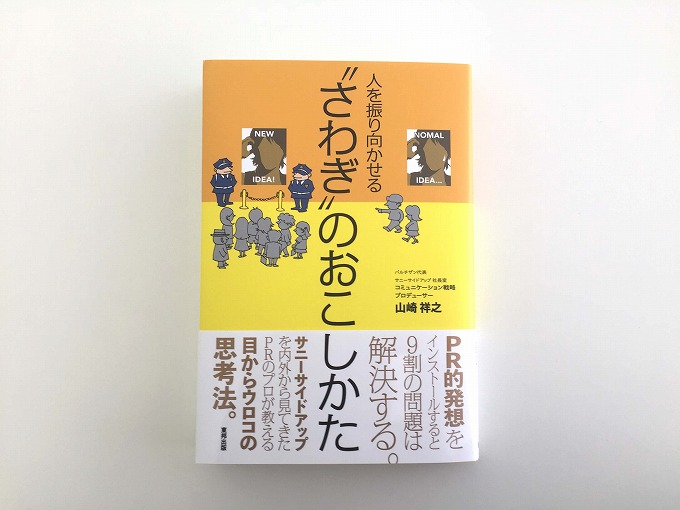
Because my book on PR thinking is being published.
The title is “How to Create a Buzz That Turns Heads,” published by Toho Shuppan and released today, November 27, 2017.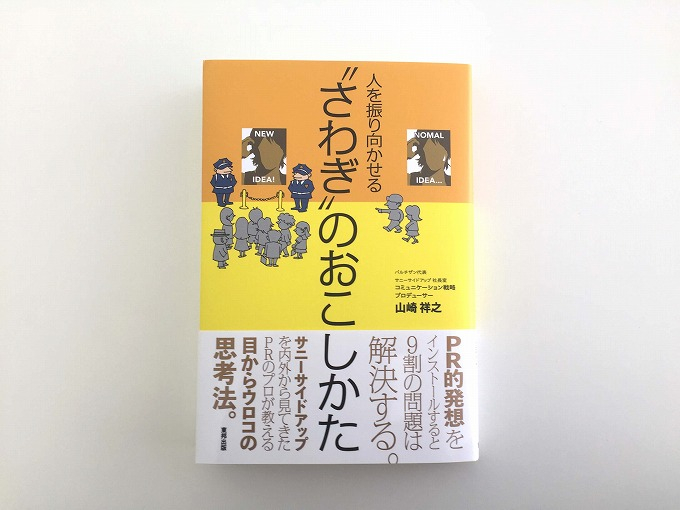
The book project itself came up over three years ago.
With encouragement from a publishing producer I knew, I was introduced to a publisher.
“Come to think of it, while there are quite a few books about the PR industry these days, it’s still rather unclear to people outside the field, isn’t it?”
“How about broadening the target readership to include ordinary businesspeople and students?”
Through such conversations, the concept was decided: a book that would allow individuals to install PR thinking.
After that was decided, I struggled with the structure under the mild pressure of making it a somewhat useful book. Furthermore, while thinking I had to write, I often—or rather quite frequently—escaped into the reality of immersing myself in work at hand. During that time, the voting age became 18, the U.S. president changed to Trump, Tokyo had three different governors, SMAP disbanded, Kochikame’s serialization ended, the Hiroshima Carp became strong, and Japanese electronics manufacturers declined.
And Prince, David Bowie, and even Ken Takakura passed away.
I’m just glad I could publish it during the Heisei era.
That aside, this book, broadly speaking, focuses in the first half on what I felt through my experiences after getting involved in the PR world, and in the latter half consolidates the essence of PR thinking through keywords and examples.
I also wrote about the thinking that “turns telling into reaching” and how to create a cause and empathy to skillfully involve people for a certain purpose, even for those not directly related to the PR industry or who aren’t PR representatives.
Writing this made me realize that most of our work is about creating a cause or building logic to gain empathy.
Working in the world of PR—or communication—means confronting head-on the habits and characteristics of humans as living beings. This isn’t a simple matter of the善 theory of human nature versus the evil theory.
Both exist in varying proportions within a single personality (though some people may lean extremely toward one side). Humans are the ones who end up participating in bullying at school or work, who write posts on the internet anonymously to thoroughly disparage celebrities, but also the ones who can’t leave a crying child alone or who rush around for disaster victims as if driven by something beyond themselves. Both factors can exist within one person. Humans are cruel, but they’re not entirely beyond redemption either.
I think we’re in a business dealing with such capricious creatures.
People live their entire lives swinging between anxiety and optimism.
With each life milestone—exams, employment, marriage, health, retirement planning—information they previously ignored suddenly becomes impossible to ignore. Other people’s problems become their own.
Both advertising and PR are inseparable from such human anxieties and desires.
It’s just a difference in approach to how smartly you enter people’s hearts.
That varies by person, and for those with strong anxiety or self-actualization needs, even web shopping ads that make you scroll vertically through extremely long pages, gradually cornering you with text that brings out deep-seated anxieties, can be quite effective.
Furthermore, humans are creatures who want to move not because someone told them to or because they’re being forced, but because they decided for themselves, and they’re creatures who want confirmation from time to time that what they decided wasn’t wrong.
I think PR is work that proceeds while respecting such multifaceted elements of human nature.
I ended up talking more seriously than expected, but the first half of the book starts from the early days of SUNNY SIDE UP, which was the catalyst for me being drawn into this world.
The original trigger was appearing as the PR company being sought for a Pacific League team’s promotional campaign—free dome admission with a kiss—which has now been completely erased from baseball history. That PR company was SUNNY SIDE UP, and Etsuko Tsugihara was the buzz personified.
Had the already-decided PR company not committed a certain breach of faith, this encounter would never have happened.
However, the first impression was oddly sales-like in speech, with a distant feeling.
Whether consciously trying to correct it or not, she used unnatural polite language like “~de gozaimashite,” like someone who had lived in Japan for a long time, completely unlike the uninhibited character I would later come to know.
I never thought for a second that this would become such a long relationship.
The office I first visited was also in a mixed-use building facing a five-way intersection about 10 minutes from Nakano Station, where a creepy bodybuilding gym sign stood out at the time. There was a mahjong parlor downstairs. The office location was chosen because the post office was nearby, and out of about eight employees, two were organizing postcards for reader giveaways.
There weren’t many frontline staff, so the DNA of having to compete with ideas to compensate for that seems to have continued from that time.
The PR industry was particularly unglamorous back then. People didn’t even know such work existed.
Around that time, apparently persuaded to try placing a job ad, Tsugihara sat in front of the phone all day, but the only calls that came were “We can do your job ads cheaper.”
Even with such a small staff, it was a lively company.
There was momentum that you wouldn’t know if you could or couldn’t do any job until you tried, so they didn’t turn things down (probably).
I had no interaction with other PR companies, so I knew nothing about them, but from that time, perhaps because everyone hardly knew the industry’s constraints, they unknowingly walked their own path and polished their own philosophy.
That’s all for now. If you’re interested, please read the book~
“How to Create a Buzz That Turns Heads“
The next installment will be posted without delay.
Rory