Professor Side’s New PR Course, Lesson 6: “Understanding Different Generations”
This is the sixth installment of Professor Side’s New PR Course.
This time, we discuss methods for understanding generations different from your own.
For example, suppose you were born in 1988 and are 30 years old.
First, pick out topics for each year over a 30-year period,
starting from when you were 0 years old—that is, from 1988.
The horizontal axis represents years, and the vertical axis represents topic categories. Divide the topic categories as follows:
① Major world and Japanese events
② Popular products
③ Popular songs and artists
④ Popular films, music, fashion, and books
Beyond these, you can add categories based on your own preferences.
For example, if you are a horse racing fan, you might include that year’s Derby winner; if you enjoy comedy, notable comedians; or the prime ministers of Japan or the United States. Baseball fans might include that year’s championship team.
After completing this work, go back 10 or 20 years before your birth year and add those entries as well. This will clarify the historical context in which people 10 years older (age 40) or 20 years older (age 50) are living today.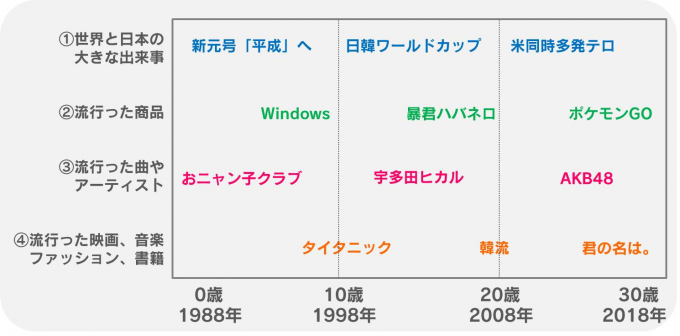
Specifically, you will understand that when the first “Star Wars” film was released in 1977, someone who is now 55 years old was in junior high school.
While you can search for this information online, there is value in creating the timeline yourself using Excel or similar tools.
As you create it, you will develop an interest in films, music, and social phenomena you were previously unaware of. The purpose of creating this table is to understand different generations and share “sentiments” with people of different generations. Through the process of creating the table, you will become interested in and explore films, music, and books you have never seen, heard, or read, deepening your understanding of “sentiments” across generations.
Understanding people from various perspectives, including generational gaps,
is essential for PR thinking and mindset.
In this sense, creating this table is extremely useful.
We recommend creating your own original timeline during breaks from work.