What did a PR planner discover to improve their planning skills? “Hints for brand communication” deciphered from masterpiece body copy

“SSU’s PR Method” is a serial project that deciphers PR techniques and branding know-how suited to the current era. This time, I would like to speak on the theme: “What did a PR planner discover to improve their planning skills?”
Click here for previous PR Method articles.
Many people in the PR industry have likely read “Narrative Company” by Tetsuya Honda. I have also read it, and the section on “narrative scripts” was particularly educational for PR planning.
First, I would like to introduce the concept of a “narrative script.” As the name suggests, this is a script that shows what kind of narrative a company wants to tell. At the same time, a narrative script is a kind of guidepost. To put it further, the ultimate form of a narrative script is to “develop all corporate activities—including product development, advertising, and PR—in line with the story you want to tell.”
Source: Narrative GENEs “Narrative scripts as a reliable guidepost. Practical marketing learned from Xylitol’s ‘Japan-Finland Project'”
However, I feel it is difficult to write a narrative script out of the blue, and I am currently struggling with how to create scripts effectively and how to train myself… (this is an ongoing challenge).
If you would like to know more about narrative scripts, please purchase the book or refer to the following links:
https://narrativegenes.com/articles/CThvT
https://webtan.impress.co.jp/e/2021/07/15/40875

As a result of my struggles, I found my own training method—though it may not be the standard approach: “Read as much advertising body copy as possible!”
What is body copy?
It refers to the main text of an advertisement. While short catchphrases (headlines) are primarily used to attract interest, the longer body copy is used to convey detailed information about a product or service, such as its appeal and benefits.
I understand that a narrative script is not something intended for the public, nor is it meant to attract people like a catchphrase. However, it seems to me that body copy contains the core of the plan and the essence of what needs to be conveyed.
This experiment is based on the idea that by reading a lot of good body copy, one might be able to create good narrative scripts.
Rather than worrying about various things and doing nothing, it is better to take action.
Easier said than done.
Better to regret doing something than to regret not doing it.
And so… the challenge begins!!
After reading a vast amount of body copy, I, Kameyama, would like to introduce my top 5 favorite selections!
1. Japan Tobacco / ROOTS Poster
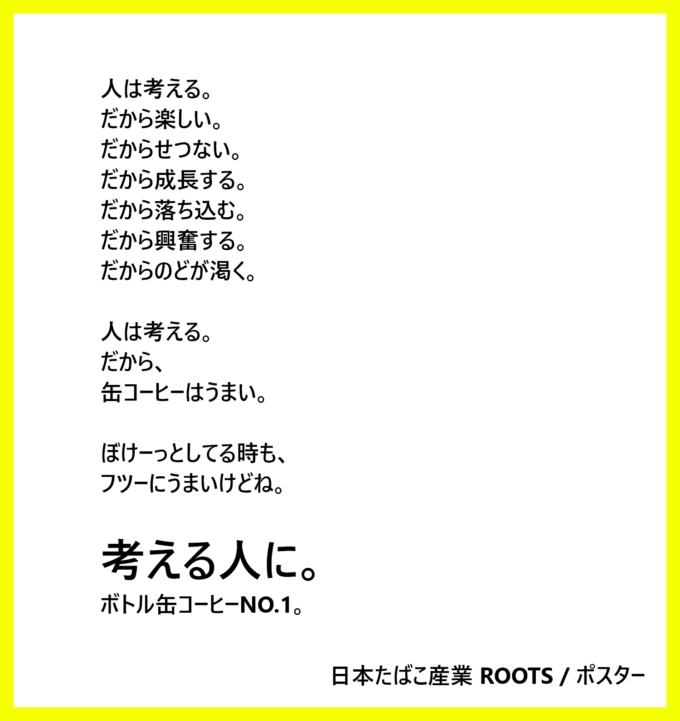
It never actually describes the features or benefits of the product.
The copywriter mentioned that they were “depicting the personality of Roots,” and it truly expresses the brand’s worldview. I felt this was very close to a narrative script in PR.
Whether the power to attract people exists depends on whether the text is for internal or external use.
However, these days I also think that if a narrative script is created for a competitive pitch to a client, it ultimately needs to be engaging, so perhaps they are the same after all.
This series has several body copy patterns, but the one I have selected here is my personal favorite.
Partly because it applies to my own work, but also because the rhythm of the “Therefore…” structure is very pleasant. I felt this was a technique that makes you finish reading the text before you even realize it.
2. Doutor Coffee Poster
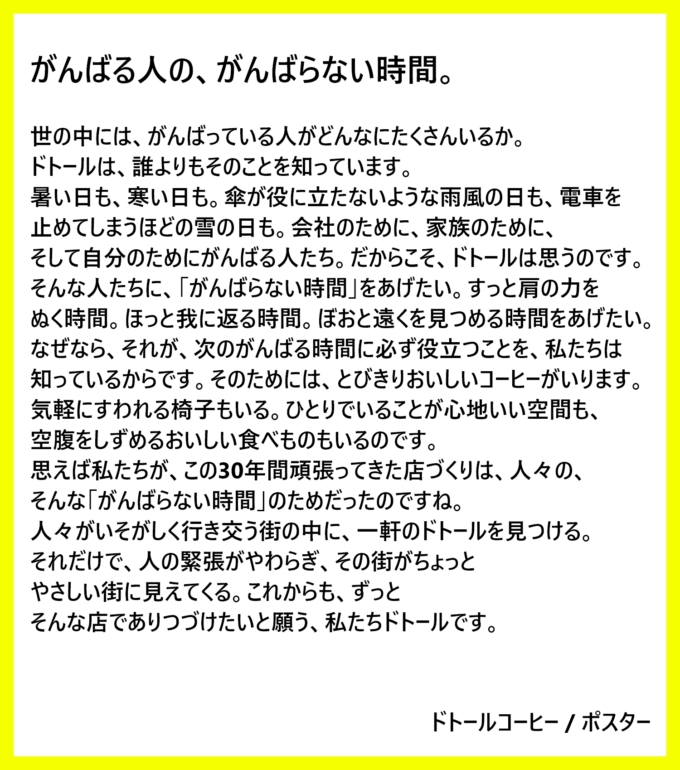
The creative director stated that this body copy positions Doutor in direct contrast to Starbucks, which is seen as slightly more pretentious.
It positions “Doutor = an ally of the working person,” providing “time to not work hard” to the hardworking people who support society.
The catchphrase creates a sense of intrigue through the juxtaposition of opposites—”working hard” vs. “not working hard”—and the body copy resolves that intrigue. There is a refreshing honesty in affirming the time spent not working hard.
I feel this body copy is also effective for employees, as it strengthens the meaning of working at Doutor. In that sense, I thought it served as a great reference for a narrative script.
3. McDonald’s Japan / QUARTER POUNDER Newspaper
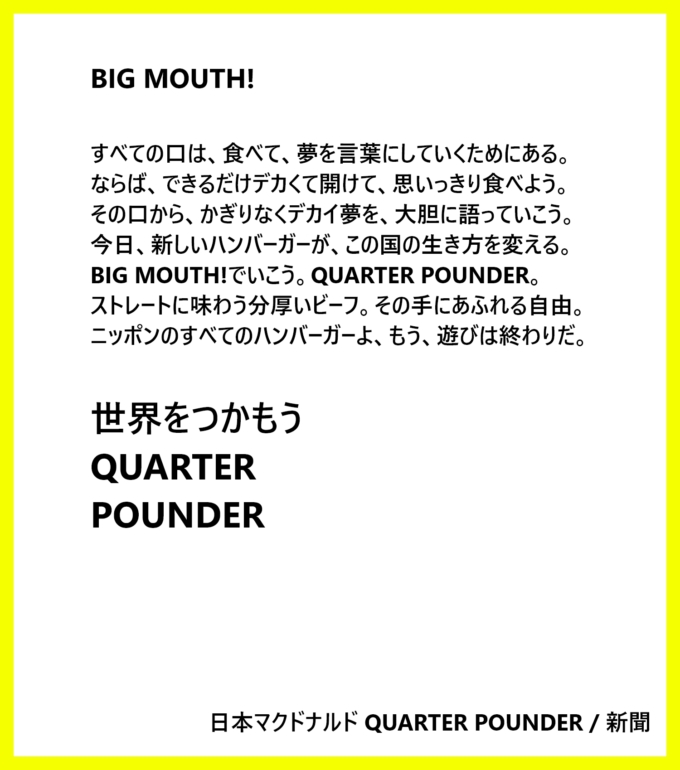
Since a new, larger hamburger was being released, they chose to have the hamburger speak about grand ideas rather than using typical appetizing expressions to show its size. I imagine they came up with the idea of “talking about big dreams” from the act of opening one’s mouth wide to eat a large burger.
I like this body copy because it crafts a personality, brand, and worldview similar to the first example, starting from the product’s characteristics.
It also reminded me of the Japanese expression for “talking big,” which often has a negative connotation. Perhaps that is why they used “BIG MOUTH!” instead of a literal Japanese translation, to avoid that negative nuance.
Furthermore, I think the “freedom overflowing in those hands” is meant to be mentally converted into meat juices, which was likely intentional.
Seeing such meticulous scrutiny of expression is wonderful, and it inspired me to be just as committed to the details.
4. ARKRAY Poster
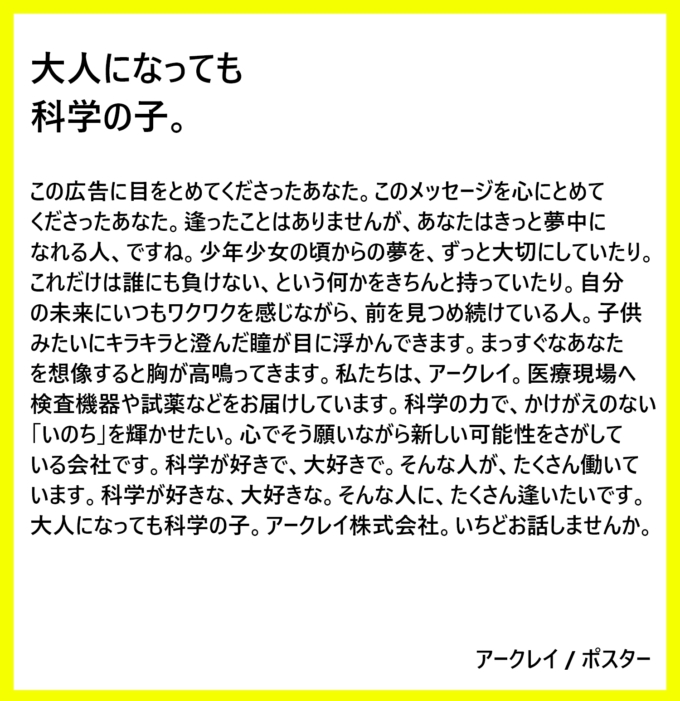
I believe this is a recruitment advertisement, and I was surprised by how much the company’s personality shines through the text.
The first-person narrative style is also excellent.
While the personality is well-expressed, it means nothing if it isn’t read. That is why the catchphrase exists, and it was great to see both the catchphrase and the body copy fulfilling their respective roles perfectly.
5. ONWARD Magazine
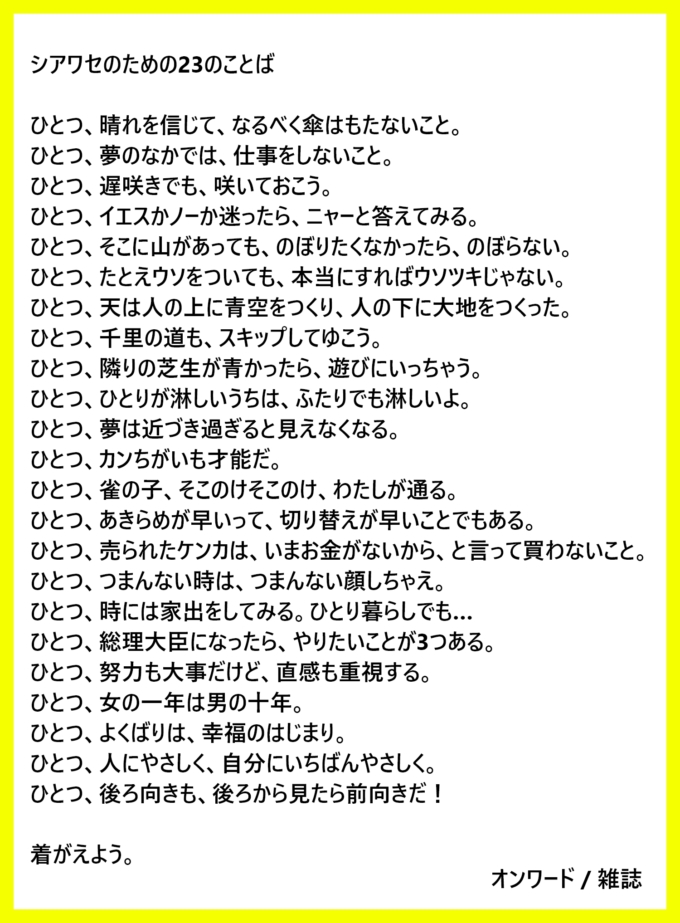
This is an advertisement for a women’s apparel brand. Like the first example, it does not directly promote service features or benefits; instead, it features a body copy with a pleasant rhythm based on the word “One…”
It is interesting how they expressed the idea of “changing your mood by changing your clothes” through a framework of 23 phrases.
Some of the words offer a gentle push or a different perspective from general perceptions, and I was impressed that they created as many as 23 phrases (since the brand is “23区,” I suppose they had to, but they likely went through more than double that many candidates).
Although the expressions are not direct, it is a wonderful piece of body copy that conveys the brand’s worldview, and I thought it was a framework that could be utilized for narrative scripts.
(Reference Books)
Narrative Company: The Power of “Stories” to Transform Corporations
Advertising Copy You’ll Want to Read Again and Again
In closing…
For now, what I thought after reading so much body copy is that I’m glad I did it. I feel my writing skills and my ability to create narrative scripts have been sharpened.
I believe there is a certain magic in self-conviction. By believing I have grown, I will continue to devote myself to planning with 120% effort every day!!
Please look forward to future blog posts from myself and other members! (And of course, if you have missed any past articles, please be sure to check them out!!)