What is the “True Value of MLB” seen at the World Series? Insights from the content production lead for the Japanese version of MLB.com
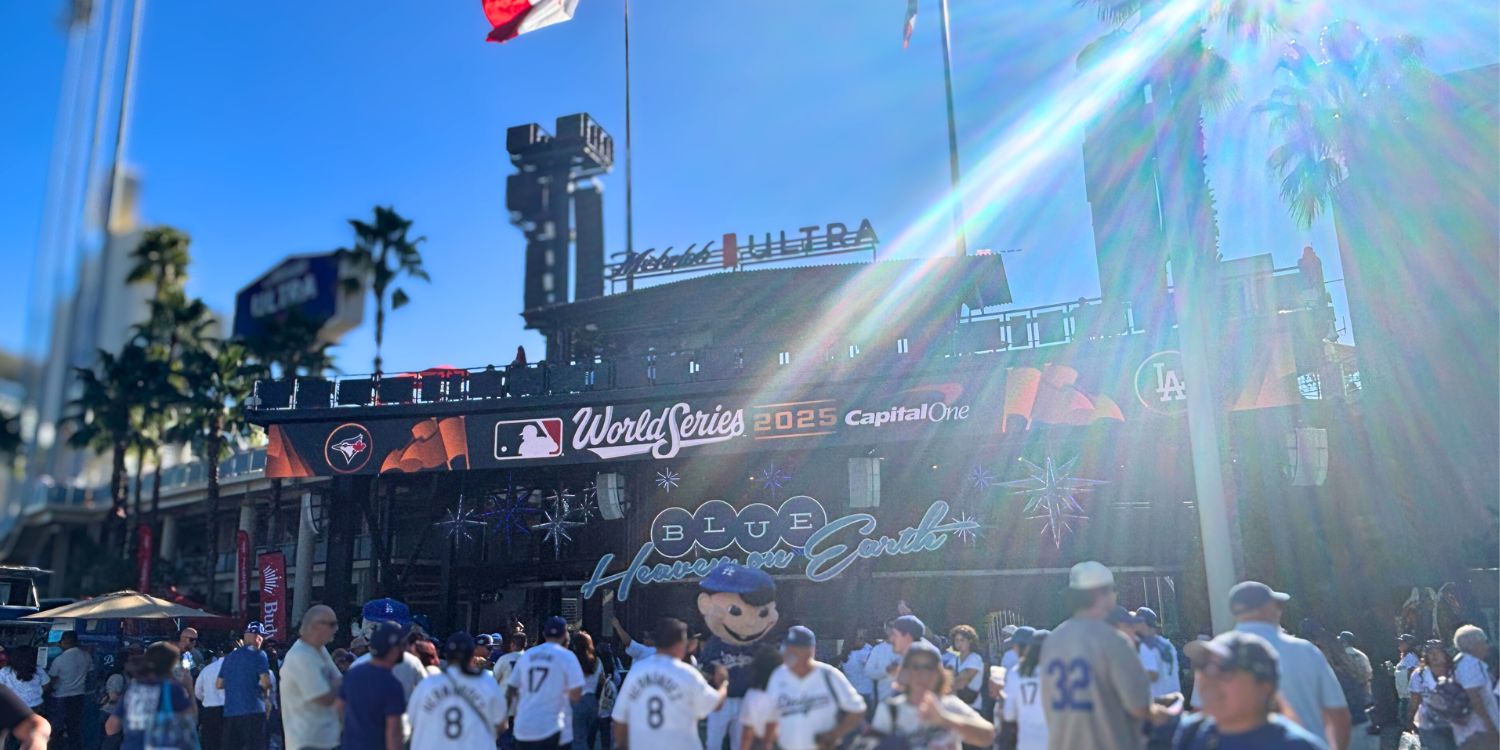
Hello. I am Ninomiya from the Sports Section of the 5th Division, Public Relations Business Headquarters. I am a devoted baseball enthusiast.
The Los Angeles Dodgers’ consecutive World Series titles have dominated the news and information programs across Japan. Three Japanese players—Shohei Ohtani, Yoshinobu Yamamoto, and Roki Sasaki—supported the team’s remarkable run, fighting through 13 games of the MLB postseason.
Furthermore, pitcher Yamamoto became the second Japanese player in history to win the World Series MVP, following Hideki Matsui. Additionally, Ohtani was unanimously voted the season MVP for the fourth time and third consecutive year. This season has surely become an unforgettable one for Japanese baseball fans.
While the 2025 MLB season concluded with such a historic series, the Japanese version of the official MLB website, “MLB.com”—which was previously only available in English—finally officially launched on the 1st of last month during the postseason!
In conjunction with the start of member registration and functional expansion of “MLB.com Japanese Edition,” SUNNY SIDE UP was responsible for the planning, progression, production, casting, and on-site coordination of the special project “My Game, My MLB.” This initiative aimed to expand site recognition and develop various content for Japanese fans to build excitement for the postseason.
This project was implemented to have celebrities who are MLB fans talk extensively about their love for the league, delivering the appeal of MLB not only to baseball fans but also to a wider audience. For the World Series, we visited Dodger Stadium for video filming to capture the realistic, high-energy atmosphere.
Please take a look at the results on the Japanese version of MLB.com below!
|
MLB.com Japanese Edition: http://mlb.com |
In this article, I would like to share the “greatness” of MLB that I felt on-site from the perspective of a baseball-loving PR professional, having had the incredibly luxurious MLB debut of watching the World Series as my first live game!
In this year’s World Series, Games 1, 2, 6, and 7 were held in Toronto, Canada, while Games 3 to 5 were held in Los Angeles, USA. This time, I will look back primarily on the three-game series in Los Angeles that I actually attended.
A Flexible Operational Structure Supporting the Games
Game 3 of the series, the first game in Los Angeles, suddenly went to 18 innings, lasting a total of 6 hours and 39 minutes. This recorded the second-longest game time in history, following 2018 (7 hours and 20 minutes). As a side note, it seems that every game where Brad Paisley has performed the national anthem—including the longest 18-inning game in World Series history in 2018—has gone into extra innings… Coincidentally, the fact that this day became a historic battle might have been due to the power of his singing voice…
|
Reference Article: By dawn’s early light: Paisley’s anthems mean an all-nighter |
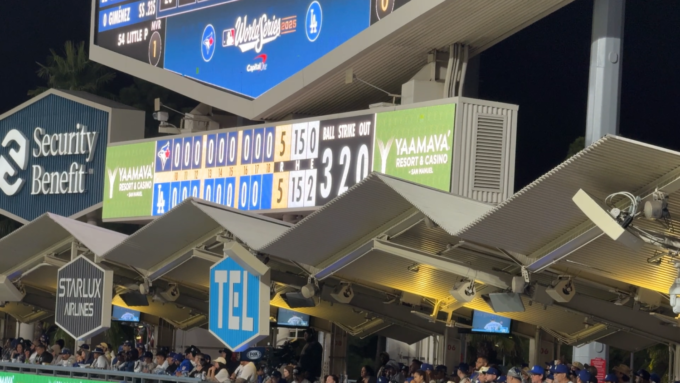
It became an incredibly long game that ended after 11:30 PM, yet most fans, including children, stayed to watch until the very end. In the NPB Japan Series, there is a regulation limiting extra innings to 12 until Game 7, making such cases rare. Consequently, I encountered a game that is uniquely MLB…
In Japan, many spectators use trains or buses to attend games and are forced to leave in time for the last train. However, Dodger Stadium is adjacent to a vast parking lot that can accommodate over 15,000 vehicles. Since many fans use their own cars or ride-sharing apps like Uber and Lyft, I had the impression that most people were watching the game without worrying about the time.
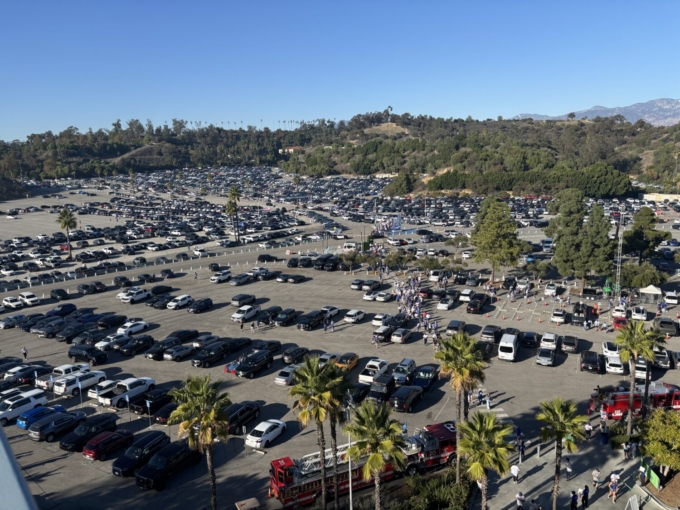
By the way, there was heavy traffic around the stadium after the game. While there may be pros and cons, I felt that even that was part of the “MLB quality” (laughs).
With a game lasting this long, even the local fans eventually lost focus, and an atmosphere of “wishing it would end soon” began to drift through the air. While both fans and players were feeling the strain, I simultaneously felt MLB’s strong determination to see the game through to a conclusion no matter what.
In fact, this year’s Dodgers entered the postseason with only one day of rest after the regular season, allowing them to maintain their regular-season momentum. Even for teams that started from the Division Series as top seeds, the interval was only five days.
Shifting the perspective to NPB, this year’s Hanshin Tigers had a staggering 12-day gap between their final regular-season game and the Climax Series Final Stage. The interval was too long, making it extremely difficult for them to play with their seasonal rhythm.
This is said to be a drawback arising from the major difference between Japan and the US: MLB plays doubleheaders the following day if a game is postponed due to rain, whereas NPB reschedules games for the end of the season.
While there are concerns regarding player conditioning and attendance issues, I felt that one of the major factors allowing MLB to suddenly schedule doubleheaders lies in their ticket sales method. In MLB, an app called “MLB Ballpark” exists, where all ticket sales and management are handled digitally, enabling flexible ticket distribution.
I’ve digressed a bit, but these innovations made me realize how flexible an operational structure has been built to ensure MLB games are completed within the schedule.
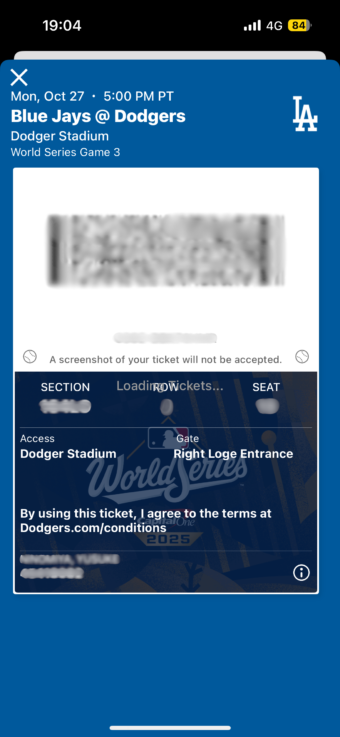
I believe that by introducing a fully digital ticket system, measures against scalping—which is a major issue in Japan—could be improved all at once…
MLB’s “Mechanisms to Entertain Fans” are Incredible
MLB’s flexibility was strongly felt not only in its operational structure but also in its “mechanisms to entertain fans,” or what we call the fan experience. I would like to share three elements that were particularly impressive.
■ “Limited-Edition Gourmet” that Attracts Fans
The first is stadium gourmet.
Even during the regular season, a wide variety of gourmet food is scattered throughout the stadium, which is enjoyable in itself. While this is also true for NPB, MLB goes a step further with “Postseason Limited-Edition Gourmet.”
Naturally, the menu types vary by stadium, but Dodger Stadium offered 13 types of limited-edition items. Perhaps because it was the World Series—the battle to determine the pinnacle of MLB—every menu item was so big it made me laugh and think, “That’s so American!” (laughs).
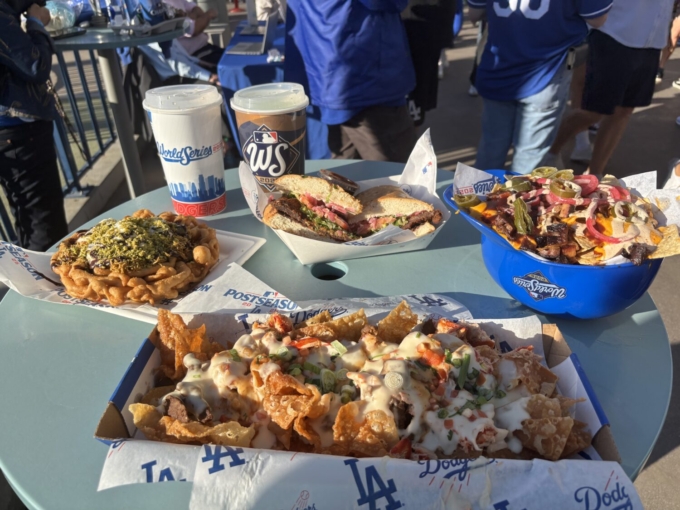
Setting aside whether the quality of taste or the quantity was optimal, I was impressed by the ability to develop and sell new gourmet items exclusively for the postseason period. Even for items that just change in size, adjustments to ingredient proportions and shapes are necessary. For entirely new items, reaching a sellable quality through menu development and cooking training must involve a significant amount of effort.
In Japan, where there is a strong obsession with food, this would be difficult to achieve in such a short period, but I felt it provided a new sense of enjoyment even for regular fans.
■ The Quality of MLB Goods Goes Beyond “Souvenirs”
The second is official merchandise.
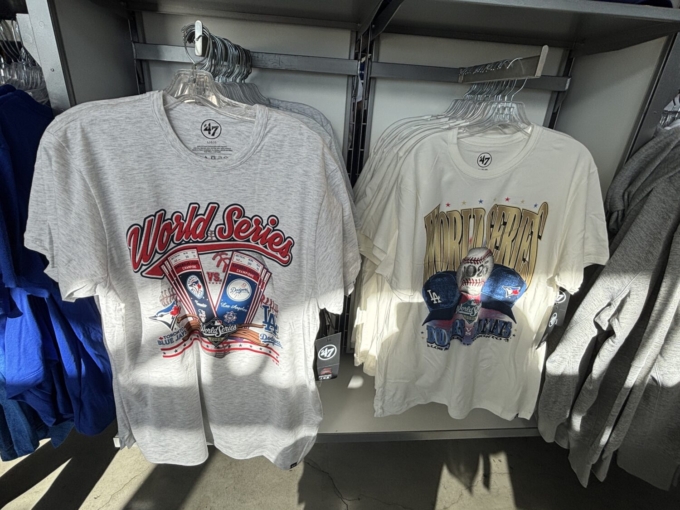
Items featuring the logos of both teams competing in the World Series are difficult to develop in many designs because they depend on the outcome of the qualifiers.
In the Japan Series, limited-edition goods featuring the logos and mascots of both competing teams are also sold, but the period between the determination of the participating teams and the event is short, giving the impression that the designs tend to be quite similar.
In contrast, there were five different designs of T-shirts featuring both team logos sold at the World Series, at least among those I could confirm.
While there are many differences between MLB and professional baseball in terms of licensing agreements and rights structures, focusing on the quality of the goods themselves, I felt that MLB sells many highly designed items that function as fashion pieces, going beyond the realm of mere “commemorative goods.”
■ Ever-Evolving Stadiums
Finally, the third element is stadium monuments.
While Japanese professional baseball stadiums also have museums where you can feel the team’s history, it is no exaggeration to say that Dodger Stadium is a “museum in its entirety.”
The walls within the concourse feature designs of legendary players from the past, creating a space that feels exciting no matter where you walk.
Among these, the “Budweiser LEGENDARY DODGER MOMENTS” was particularly impressive. In the exhibition corner of the outfield seats, historic team highlights and the achievements of legendary players were introduced.
What surprised me this time was that a monument was already on display for Ohtani’s performance in the MLB League Championship Series on October 17, 2025 (October 18 Japan time), where he hit three home runs as a batter and recorded 10 strikeouts over 6 1/3 scoreless innings as a pitcher.
The speed of posting something new in just over a week strongly reflects MLB’s flexibility and its commitment to pleasing fans.
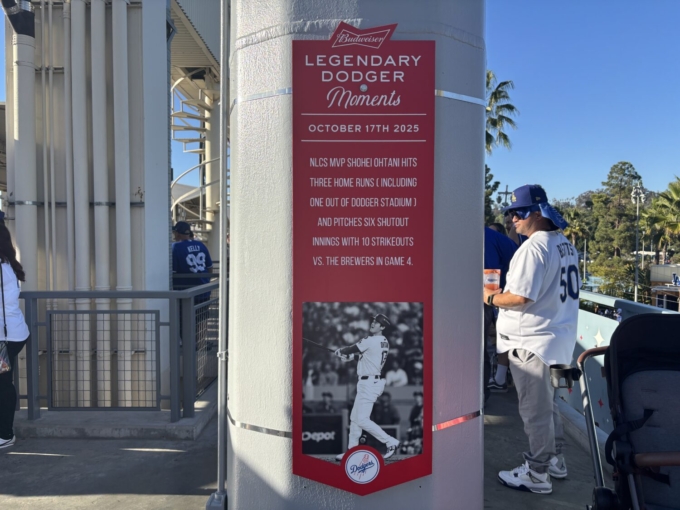
The stadium I visited just the other day has already been updated…
The fact that there are new discoveries and enjoyments no matter how many times you visit reflects MLB’s “ever-evolving attitude.” By valuing the moments that please fans, MLB consistently delivers a fresh fan experience.
I made all these discoveries in just three days, and I believe there are still many more ways to enjoy it. I truly felt that “every fan being able to savor baseball in their own way” is the “ultimate spectator experience” that MLB provides.
In Closing
It is now my fifth year since joining the company as a new graduate. Having played baseball since elementary school, I spend my days deeply appreciating how fortunate I am to be working on MLB-related projects.
I believe there are plans I can propose and discoveries I can make precisely because of my “passion” for the sport. I am grateful for an environment that allows me to “turn a hobby into a career.”
Currently, Japanese players are performing exceptionally well in various MLB teams, and attention toward MLB within Japan is reaching new heights. We will continue to work toward creating a “fun stir” to further communicate the appeal of MLB and expand its fan base!
SUNNY SIDE UP handles PR and communications for various products and services, including sports.
What can be achieved through the power of communication? We welcome consultations starting from such questions. Please feel free to contact us using the “CONTACT” button below.