Explaining the Key Points from Writing to Distributing Press Releases! Introducing the SUNNY SIDE UP Style Guide, Crafted Through Hundreds of Releases Annually

The “SSU PR Method” is a series that deciphers PR techniques and branding know-how suited for the modern era. In this installment, we would like to explain the basics of public relations activities: how to write and distribute press releases!
Click here for previous PR Method articles.
If you are a public relations officer or work for a PR agency, you likely search for information and angles to serve as press release material every day. This might involve scouring PR TIMES to see what other companies are doing or rapidly scrolling through news articles to check what the world is interested in.
The reason we worry so much about what to write every day is to maximize media exposure for our company and its services, and to prevent the loss of exposure opportunities. Furthermore, a press release is not finished once it is written and distributed. Because these are official documents, they serve as a companion that allows for clear explanations when promoting to the media.
In this article, we will explain the following:
1. How to write a press release
2. Proposed angles for press releases
3. How to distribute press releases
1. How to Write a Press Release
What is a Press Release? >>>
A press release is a necessary document for announcing unreleased news all at once. It officially communicates the same information at the same time to multiple media outlets. Recipients span various media genres such as television, newspapers, magazines, and the web, and their level of knowledge varies depending on their department, position, age, and skills. Additionally, it is said that editorial departments receive approximately 400 press releases a day. Therefore, “clarity” that anyone can understand and an “angle” that makes one want to turn the release into an article are crucial.
Since how to write a press release (preparation before writing and the structure of a press release) is often explained on other sites, this article will focus on key points.
Point 1:
Write Accurately and Concisely – 5 Key Tips
1. State facts accurately
2. Put the conclusion first
3. Minimize technical jargon
4. Avoid advertising-like expressions and excessive adjectives
5. Include numerical data and evidence
Point 2:
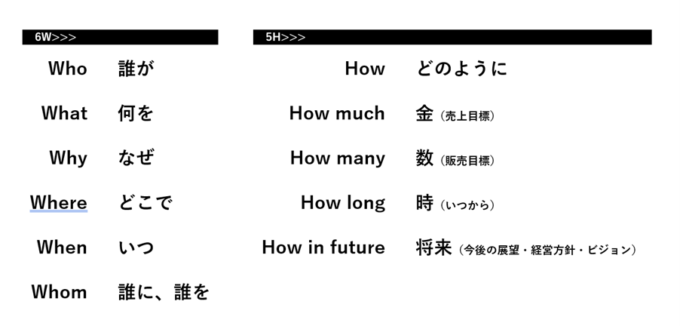
Incorporate “Background and Future Potential” Based on the 6W5H
Point 3
3 Rules for Creating Titles

2. Proposed Angles for Press Releases
We have summarized these into project angles and personal angles within the company.
6 Angles for “Projects That Journalists Can’t Resist”
The following six are representative angles. If it is difficult to find an angle internally but you still want to be covered, one method is to have someone look from a third-party perspective to discover “charms you haven’t noticed yourselves” and create a fresh angle. Doing so can increase the probability of being interviewed.
1. Corporate Stance
Needs: Launching a training app that connects users with fitness trainers via smartphone, as people spend more time at home and seek easy exercises they can do there.
Problem Solving: Developing a service where children can be left safely on an hourly basis, as balancing sudden remote work and childcare becomes difficult.
Challenge: Aiming for the liberalization of energy sources, a service that makes people want to choose natural energy will stop global warming.
2. Technological Innovation
Adoption of New Technology: The world’s first restaurant where euglena is the main dish opens.
Technical Application: A watchmaker’s detailed and precise technology enters the space development field.
3. Popularity
Big Hit/Sold Out: A limited-edition premium model hoodie sold out in just 3 hours after reservations opened.
Rapid Growth: Sales of portable air purifiers increased by 200% compared to last year, partly due to the trend in infectious disease prevention. Endorsement: Headphones that e-sports players all use regularly.
4. Collaboration
Collaboration with Other Companies: To increase the number of eco-friendly offices, an office real estate company collaborated with a landscaping design company to start offering renovated “clean office” properties.
5. Generation
Supported by a Specific Generation: 70s and 80s fashion becomes a trend among teens.
6. Seasonal Events
Season: Just before Golden Week, variety goods are released to help children spend time without getting bored during long car trips back to their hometowns.
Personal Angles That Make the Media Want to Interview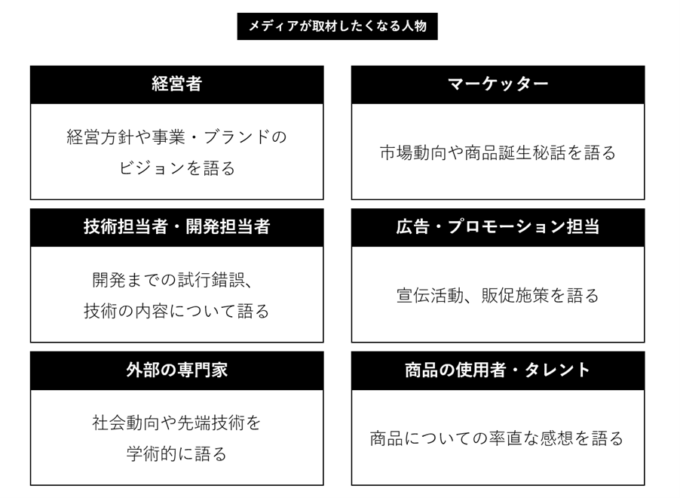
If you are having trouble with material or angles for press releases or newsletters, please try reviewing your company’s information from the perspectives above. You might find dormant information that has not yet been sent to the media or explored in depth.
3. How to Distribute Press Releases
Once you have created a press release based on the tips above, the next step is distribution. Distribution methods are mainly divided into two types: “Mass” and “Individual.”
There are several methods for mass distribution, the most representative being the use of distribution services like PR TIMES. A characteristic of this method is that it allows for the simultaneous distribution of releases to multiple media outlets, including those with which you have no prior relationship.
Another method is submitting to press clubs. Press clubs are organizations created for major media outlets to cover and report on public institutions such as government offices. They are often located within government buildings, prefectural offices, or chambers of commerce, and an application is required before distributing a release.
For individual distribution, email is the mainstream method, but depending on the media, such as print publications, you may be asked to send it via FAX. You select the appropriate reporters, editors, and outlets from your company’s media list based on the content you want reported. For emails, the guideline for attachments is within 3MB, and the number of images should be around 3 to 5.
Tips for Email Titles to Increase Open Rates >>>
Including the following information makes it easier to catch the eye of media personnel:
✓ Company name
✓ Briefly state what the information is about and who should read it
✓ Write the date and time after the company or service name (so it is displayed even before the email is opened)
In this “SSU PR Method,” we explained press releases. While we focused on key points, the recently released book “SUNNY SIDE UP’s Step-by-Step PR” explains these topics with diagrams and easy-to-understand layouts.
It also covers a wide range of almost everything related to PR, such as planning and digital promotion measures, so we would be happy if you would consider purchasing it.
Click here for the article about turning the internal manual into a book!
Publishing an Internal Manual?! “SUNNY SIDE UP’s Step-by-Step PR,” a manual packed with almost all of SUNNY SIDE UP’s operations, is now on sale!
In the next “SSU PR Method,” we will explain newsletters! Please take a look here.
8 Media Hooks for Newsletters That Increase the Probability of Gaining Publicity: Introducing the SUNNY SIDE UP Style Guide (Newsletter Writing Version)!!
About the Author
Public Relations Business Division
Account Planning Bureau, Planning Department Group 1
Kazuki Kameyama
Two and a half years have passed since joining SUNNY SIDE UP as a mid-career hire to acquire planning skills. I belong to the same generation born in 1992 as former Nogizaka46 member Mai Shiraishi and host Roland, but lately, I feel a sense of urgency that I haven’t made as much of an impact on the world as they have. My favorite member is Mei Higashimura from Hinatazaka46. Everyone, please support Mei-mei.
*Affiliation is at the time of writing the article.