A must-read for PR planners! Learn the core principles of planning | A taste of “SUNNY SIDE UP’s Step-by-Step PR”! Vol. 3
Hello! I’m Oku, the editor in charge of this series.
Even within PR agencies, there are many different types of work—one of them is “planning.” In my day-to-day work as a planner at SUNNY SIDE UP, I create and propose plans. When people ask, “What kind of job is it?” it really varies—it’s a broad role with a wide range of responsibilities…
In general, the work involves identifying issues related to marketing and PR/public relations for companies and public institutions, developing a plan, and presenting it.
This time, we introduce Chapter 3 of the book, which focuses on planning work. It is a must-read not only for those who aspire to become PR planners, but also for anyone who wants to learn the basics of marketing, as it also touches on key marketing frameworks.
• Aspiring planners who want to learn the basics
• Solo PR professionals who want to implement new in-house initiatives—not just handle media relations
• Those who want to try their hand at proposing plans
• Those who want to learn representative marketing frameworks
We hope this will be helpful to you…🍳
(And of course, we also welcome your inquiries and consultations with SUNNY SIDE UP!)
■ Introduction
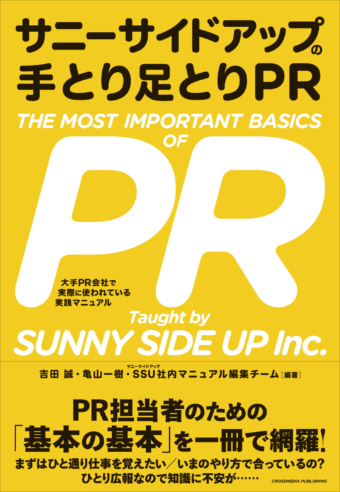
This article is part of a series that introduces selected excerpts from the manual book for PR beginners and solo PR professionals, “SUNNY SIDE UP’s Step-by-Step PR,” published in May 2021.
Previous articles are here ▼
[New Series Launch] A taste of the PR manual book “SUNNY SIDE UP’s Step-by-Step PR”! Vol. 1
If this article made you think, “I want to know even more!” or “I’d love to keep a copy on my desk!” we would be grateful if you would purchase the book at bookstores, on Amazon, and more.
To purchase on Amazon, click here.
If you have any questions about the book or would like to learn more details, please feel free to click the “CONTACT” button (bottom right on PC, or at the bottom on smartphone)!
Now, let’s dive in and take a quick taste of what’s inside!
■ Planning basics: Thinking in terms of strategy and tactics
The elements of a proposal can be broadly divided into “strategy” and “tactics.” Understanding how strategy and tactics differ, and how each should be developed, is an essential action for selling a product.
In this chapter, we will clearly explain frameworks for planning, from the fundamentals to how to generate ideas.
What is strategy? What are tactics?
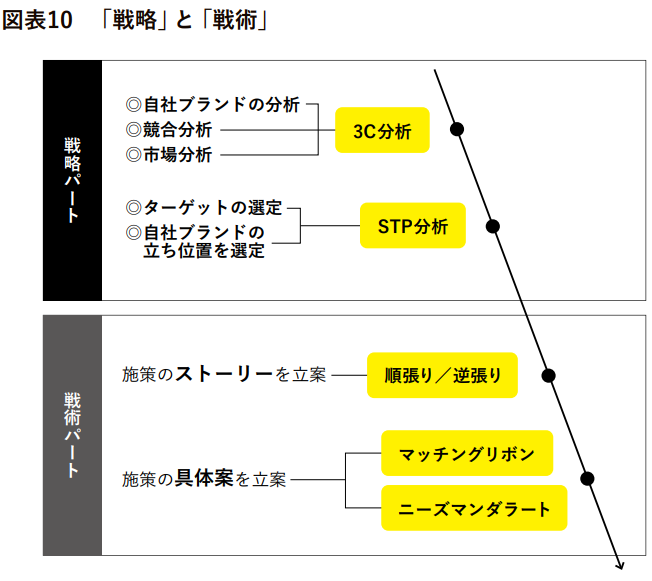
Strategy and tactics are not effective unless they are consistent (aligned). Even when considering either one, it is necessary to always keep the “big picture” in mind
10>.
What is strategy?
Strategy is the part where you determine the direction to take, the concept, the message to communicate, and more, based on analyses such as overall market analysis, competitor analysis, and internal analysis. Think of it as a scenario developed from a comprehensive perspective—such as “what to do” and “what not to do”—in order to achieve a certain objective.
As methods for deriving strategy, we will introduce “3C analysis” and “STP analysis” here.
*For “STP analysis,” please be sure to refer to the book!
What are tactics?
Once the strategy is decided, “tactics” are how you will realize that scenario. This is the part where you set the direction of initiatives and propose concrete ideas. Consider which means are most effective for achieving the objective, and build your tactics accordingly. We will introduce “following the trend / going against the trend” for creating the story of an initiative, and “Matching Ribbon” and “Needs Mandalart” for developing concrete proposals.
*”Following the trend / going against the trend” is introduced in this article!For “Matching Ribbon” and “Needs Mandalart,” please be sure to refer to the book.
■ Building strategy from analysis (1): 3C analysis
3C analysis is a marketing framework named after the initials of Customer (market/customers), Competitor (competition), and Company (your company). Its key feature is that it is simple and makes it easy to organize and understand the current situation by analyzing a business from these three perspectives
11>.
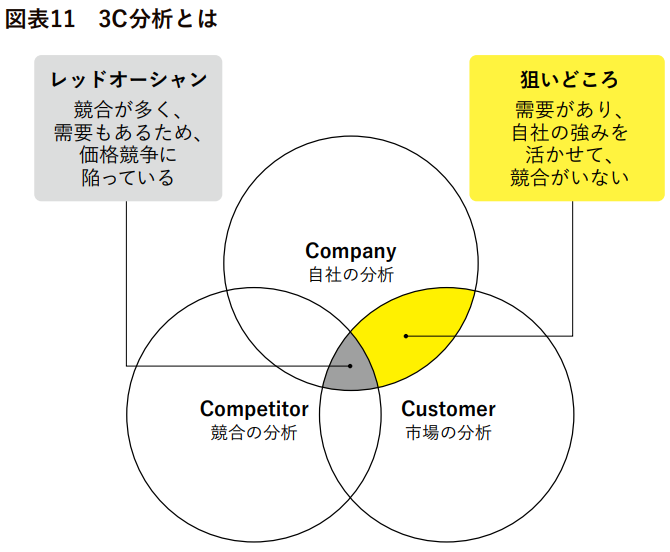
Typical items to consider from each perspective include the following.
Key points of 3C analysis
Customer (market/customers)
◉ Market size and trends in the industry, growth potential
◉ Customers’ purchasing/consumption behavior, explicit/latent needs, dissatisfaction and concerns
Competitor (competition)
◉ Current share and trends of each competitor
◉ Characteristics of each competitor, such as strategies adopted and resources held
◉ Competitors’ position within the industry
◉ Strengths and weaknesses
◉ Asset value such as history and story
Company (your company)
◉ Corporate philosophy and vision
◉ Current status of existing businesses/your products (sales, share, product lineup, strategy, etc.)
◉ Characteristics, strengths, and weaknesses of existing business
◉ Current resources in people, goods, and money; strengths and weaknesses
As an example of 3C analysis, let us use the case of “PG’s mop.”
For floor-cleaning products, the mainstream used to be mops that you wet with water and wipe the floor with, and consumers accepted that as the norm. However, there were complaints about the mop becoming heavy due to water and dirty water dripping onto the floor.
In addition, because mop functions were the same across companies, the market fell into price competition.
In response, PG listened to consumers and developed a “mop that does not require water.”
By launching a mop that removes dust from floors using static electricity, they created a product that resolved dissatisfaction with conventional mops and were able to stand out in the market.
■ Conclusion
Thank you very much for reading this series, [A taste of the book “SUNNY SIDE UP’s Step-by-Step PR”]!
Past articles in the series are available here, so if you have even a little room left, why not sample one more item?