Survey PR and Crisis Management PR: Explaining Often Overlooked PR Methods! | A Sneak Peek at “SUNNY SIDE UP’s Step-by-Step PR” Vol. 2

Hello! This is Oku from the Account Planning Division.
When you think of PR methods, things like “press releases” to deliver new information to the media or PR events such as “press conferences” probably come to mind.
However, there are various other PR methods, and by combining them effectively, you can move closer to solving issues and achieving goals.
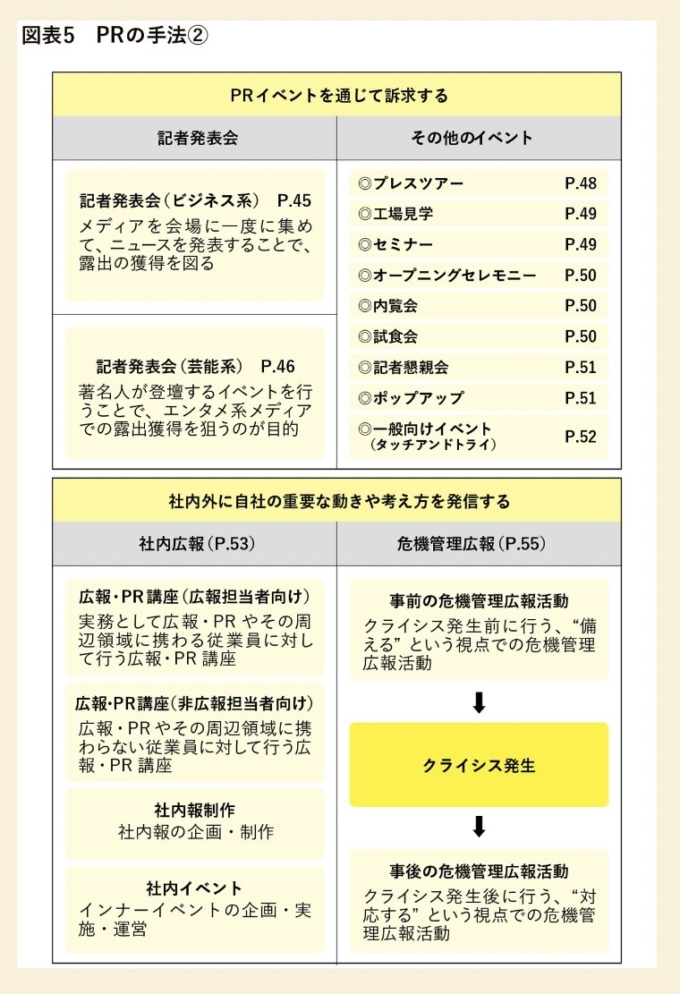
(From book pp. 25, 26, Figures 5, 6)
Among the many methods available, those often missed in basic training include methods that start with creating facts beforehand, such as “Survey PR” and “Awareness PR,” as well as methods for communicating important company movements and philosophies internally and externally, such as “Internal PR” and “Crisis Management PR.”
These are very important, but it feels too late to ask now…
I want to brush up on the basics again…
Many PR representatives and PR agency staff likely feel this way.
In Chapter 2 of our manual, which is packed with SUNNY SIDE UP’s expertise, we explain various PR methods one by one. From that chapter, we have selected and introduced pages that explain “Survey PR,” “Awareness PR,” “Internal PR,” and “Crisis Management PR”!
■ Introduction
This article is part of a series that introduces excerpts from the manual published in May 2021 for PR beginners and solo PR practitioners, titled SUNNY SIDE UP’s Step-by-Step PR.
Click here for the previous article ▼
[New Series Launch] A Sneak Peek at the PR Manual “SUNNY SIDE UP’s Step-by-Step PR” Vol. 1
If this article makes you want to learn more or keep a copy on your desk, we would be delighted if you would consider purchasing it at bookstores or on Amazon.
Click here to purchase on Amazon
If you have any questions regarding the book or would like to know more details, please feel free to click the “CONTACT button” (bottom right on PC, bottom of the screen on smartphones)!
Now, let’s dive right into the contents of Chapter 2!
■ PR Starting from Pre-emptive Fact-Building
A common PR approach is “Survey PR,” where PR topics are developed based on survey results and then disseminated.
As a more advanced approach, there is also the concept of “Awareness PR.” Instead of promoting a product or service from the start, this method involves first shaping the public mood and engaging from a stage where the product or service becomes a necessity.
What is Survey PR?
This is a PR method where questionnaire surveys related to a company, product, or service are conducted, and the results are disseminated as news. Based on data that can substantiate the content, survey releases or newsletters are created to generate buzz and secure media exposure.
This is an effective method not only when there is no information on new products or services, but also when you want to establish corporate branding or guide public opinion in a positive direction for your company.
The flow of implementing Survey PR can be divided into four stages: (1) Survey Design, (2) Fieldwork, (3) Analysis Release Creation, and (4) PR Activities.
1. Survey Design (1 week to 1 month)
Determine what kind of hypothesis you want to substantiate with facts, create a survey plan, and design the questions. Since the required period is approximately one week to one month, work backward from the timing you wish to distribute the survey release or newsletter. It is common to aim for a sample size of at least 400 to 500 people.
2. Fieldwork (1 week to 1 month)
Collect responses through internet research, as well as telephone, mail, street surveys, group interviews, and individual interviews.
3. Analysis Release Creation (1 week to 1 month)
Analyze the research results and create survey releases or newsletters. By performing “cross-tabulation”—analyzing results by combining factors such as gender, age, occupation, and place of residence—rather than just simple tabulation, you can firmly establish and refine the news and messages you want to promote.
4. PR Activities (1 to 2 weeks)
Approach the media based on the survey release or newsletter. Propose projects using the objectivity based on the survey and the novel results revealed by the research as hooks. The key is to manifest things that people vaguely feel, such as “now that you mention it, that’s true,” or to highlight unexpected findings, such as “I thought it was this way, but it was actually different.”
Example: Survey PR for Solo Camping
Is Solo Camping Still a High Hurdle!? A 20% Gap Between Those Interested and Those Without Experience!!
In conjunction with Mountain Day on August 11, the Solo Camping Promotion Council conducted a questionnaire survey targeting individuals aged 20 to 64 nationwide. The questionnaire consisted of about 10 questions, such as “Have you ever gone solo camping?”, “Where would you recommend for solo camping?”, and “Have you never gone solo camping but are interested?” While confirming the high level of interest in the solo camping boom across a wide range of generations, the survey also highlighted the reality that many have yet to try it. Furthermore, since the survey also investigated the favorite campsites and camping gear of experienced solo campers, recommended locations and goods for beginners were also announced in a ranking format.
Recommended Solo Campsite Ranking
1. ……………………
2. ………………
3. ……………………
Recommended Solo Camping Gear Ranking
1. ……………………
2. ………………
3. ……………………
What is Awareness PR?
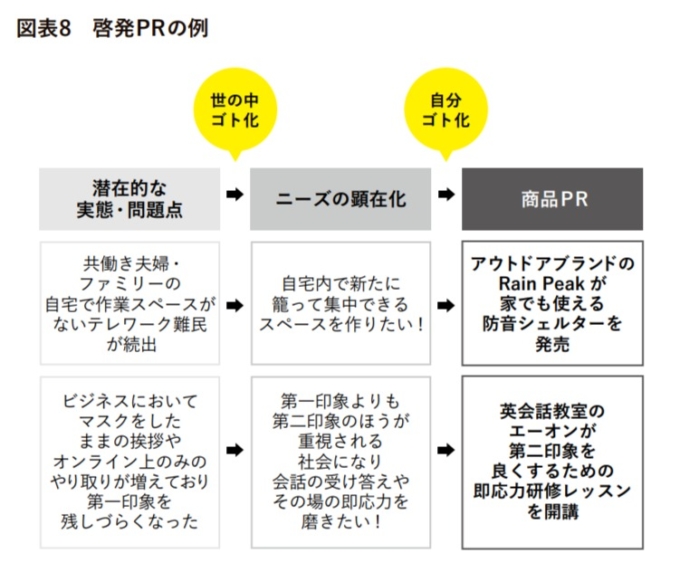
The method of first forming public opinion or a movement before promoting a product or service is called “Awareness PR.”It involves visualizing potential issues that have not yet become “public matters” as needs, thereby creating an atmosphere where the value of what you want to promote is sought after. By promoting the target objective after this, more effective communication becomes possible.
To turn an issue into a “public matter,” it must actually align with current trends, and it is important that many people can empathize with the identified needs(Figure 8).
*The “Solo Camping Promotion Council” mentioned in the text is a fictional organization.
■ The Growing Importance of Internal PR and Crisis Management PR
When people think of PR activities, they often first think of “disseminating information through the media.” However, internal PR—communicating “what the company values” to employees so they can work toward the same goals—is also very important. In recent years, as work styles have become more diverse, an increasing number of companies are focusing on this area.
Furthermore, even if the utmost care is taken in business operations, the possibility of unforeseen circumstances is never zero. Therefore, it is essential to have knowledge of PR related to crisis management.
Various Internal PR Activities
With the increasing diversification of work styles, more companies are focusing on internal PR. Here are some of the main activities.
Internal PR
Internal PR refers to inner communication directed at a company’s important stakeholders, including group companies, partner companies, employees and their families, and shareholders.
By helping stakeholders gain PR literacy, PR activities can proceed more smoothly. It can also contribute to business growth by increasing employees’ understanding of and affection for the company. In recent years, internal PR has become a particularly high-profile field within the PR industry.
PR Lectures (for PR Representatives)
These are lectures for employees involved in PR, advertising, and marketing to learn PR theory and how to create press releases as part of their practical duties.
PR Lectures (for Non-PR Representatives)
There are also lectures designed to help employees in departments other than those with established PR literacy (such as PR, advertising, or marketing) acquire basic knowledge about PR.
By helping them gain literacy, companies can expect smoother operation of PR activities and more PR topics being raised from the front lines.
Internal Newsletter Production
This involves the planning and production of internal newsletters aimed at instilling corporate visions and business details, sharing information between group companies, branches, and departments, and fostering communication among employees. These can also be produced as paperless content, such as email newsletters or publications on groupware.
Internal Events
This involves the planning, implementation, and management of inner events aimed at sharing a sense of purpose, revitalizing communication, and improving motivation.
The types of events are diverse, ranging from company-wide or department-level training and social parties to anniversary events, award ceremonies, and even sports days.
Pre-emptive Crisis Management PR Activities
Crisis management PR involves situations where a company may face social criticism, such as product recalls by home appliance manufacturers, foreign object contamination for food manufacturers, food poisoning at restaurants, or employee social media troubles and online backlash in the service industry.
While people often associate this with post-crisis responses like apology press conferences, it is also possible to prepare from the pre-occurrence stage with a perspective of “preparing for a crisis.”.
This section and the next will explain “pre-emptive” and “post-event” crisis management PR activities, respectively. First, we look at crisis management PR activities from the perspective of “preparing” before a crisis occurs.
Crisis Management Consulting (Pre-emptive)
Based on interviews and other methods, experts help identify potential risks faced by the company and provide advice on building a crisis management PR system.
Crisis Management PR Manual Creation
Based on the consulting content, the crisis management PR system, communication and instruction chains after an occurrence, and response procedures are documented in a manual..
Media Training: Press Conferences
Simulations are conducted for press conferences that may be held after a crisis occurs. In a venue set up to resemble a press conference hall, participants practice presentations and QA sessions with people acting as reporters and camera crews.
Media Training: Interviews
Simulations are conducted for media interviews that may take place after a crisis occurs. In a one-on-one individual interview situation for potential interviewees, participants practice their responses and behavior during the interview.
Post-Event Crisis Management PR Activities
These are crisis management PR activities from the perspective of “responding” after a crisis has occurred.
Crisis Management Consulting (Post-Event)
After anticipating the impact on the media and society when facts are disclosed, a response plan is developed and expected QAs are created.
Press Release Distribution
This involves formulating statements for the disclosure of facts, as well as creating and distributing press releases.
Monitoring Support
This involves media monitoring after a crisis announcement and subsequent media analysis. It also includes monitoring social media reactions to reports and the spread of online backlash.
Press Conferences
This involves the planning, production, management, and on-the-day response for press conferences held to disclose facts. Media relations before and after the press conference are also handled.
While such preparation and knowledge are important, the most vital elements when something actually happens are sincerity, accuracy, and speed. Responses are handled with the top priority of minimizing damage caused by the incident.
Source/Reference: SUNNY SIDE UP’s Step-by-Step PR (CrossMedia Publishing)
■ Conclusion
Thank you for reading this installment of the series [A Sneak Peek at the Book “SUNNY SIDE UP’s Step-by-Step PR”!].
Past articles in the series can be found here, so if you still have a little room left, why not try another dish?