[How to Grow Your Subscribers to 100,000?] Six Reasons Your YouTube Views Aren’t Increasing | SSU Digital Lab Vol. 1
*Updated on Wednesday, September 22, 2021, with items 4–6.
Hello! I’m W from Division 2, Public Relations Business Headquarters at SUNNY SIDE UP.
At SUNNY SIDE UP, to “create fun buzz,” we fully leverage not only PR but also digital communications such as social media and influencers!
However, unfortunately, we still sometimes hear comments like, “I didn’t know SUNNY could do digital too!”
So, we have launched a new series, “SSU Digital Lab,” to introduce SUNNY SIDE UP’s approach to digital work!
For our first installment, we are focusing on YouTube!
Having provided YouTube consulting and production and grown a channel from 0 to 100,000 subscribers, I will explain the “six reasons your YouTube views aren’t increasing.” If you work in PR or manage social media and use YouTube, we encourage you to read on.
[Table of Contents]
・Reason #1: The channel’s direction is not clearly defined
・Reason #2: There is no uniqueness
・Reason #3: You are not meeting viewers’ needs
・Reason #4: The filming environment is not properly set up
・Reason #5: You are not creating titles that capture the key points
・Reason #6: There is no effort to keep viewers engaged
Reason #1: The channel’s direction is not clearly defined
The most common mistake is operating without a strategy.
Right after launching a channel, you may start planning with ideas like “Let’s post stylish videos!” or “Let’s do something fun like this!” and then upload videos blindly—“Let’s just do 50 for now!” If you do that, the channel is likely to fail.
First, clearly define your main target audience and the overarching purpose of why you are using YouTube in the first place.

By clarifying (1) your main target and (2) your overarching purpose, you can create consistency in the tone and content of your videos and establish your channel’s brand.
For example:
Publishing videos for working millennial women,
and aiming to drive attendance for your company’s recurring seminars.
Helping homemakers understand the usability of a new product your company will launch next month,
and leading them to purchase on your e-commerce site.
By clarifying your main target and overarching purpose in this way, you create overall consistency and can build a channel that grows.
Reason #2: There is no uniqueness
In recent years, YouTube has become crowded, and channels can no longer grow without clear differentiation.
Around 500 hours of video are uploaded every minute worldwide, and as of 2021, Japan alone has 65 million users (ages 18–64). As a result, the number of creators has also increased and competition has intensified.
To help viewers find your videos among countless others, it is essential to think about what makes you unique—in other words, “the value only this channel can offer.”
Uniqueness can come from:
A. The on-screen talent (character, distinctive skills, etc.)
B. The presentation (speaking style, editing, etc.)
C. The concept (topic, structure, etc.)
Create it by combining these three elements in a way that feels as unexpected and rare as possible.
When you look at it this way, it is a similar way of thinking to PR.
Example)
A. An office worker who eats 300 cakes a year
B. In ultra-high video and audio quality
C. Reviews every kind of cake, from convenience stores to luxury shops
A. An English teacher with a university acceptance rate of over 90% at top-tier schools
B. Using rap
C. Explains English vocabulary for exam takers.
And so on.
We recommend selecting around five or six benchmark channels. As you consider what to learn from them, you can create a positioning map and identify areas for differentiation.
Reason #3: You are not meeting viewers’ needs
Some of you may be thinking, “I’m making interesting videos with direction and uniqueness in mind—so why aren’t they growing?”
In many cases, you are filming what you want to shoot, rather than what viewers want to know.
Celebrities and influencers with followers on other platforms are exceptions, because “what fans want to know = what they want to film.” However, for companies and individuals using YouTube for business purposes, you should think about themes and angles with the intention of solving viewers’ problems.
The key point for thinking about themes and angles is the “customer journey.”
For example, if you consider the theme of “fashion,” there are phases such as “buy,” “wear,” “care for,” and “dispose of” clothing.
The movement of users progressing through multiple phases in sequence is called the “customer journey.”
Actions, questions, and concerns differ completely depending on each phase of the customer journey.
Specifically imagine your viewers—“What are they thinking at what time, and what challenges are they feeling?”—and create videos that solve those challenges.
The key point is not “posting the videos you want to post,” but “posting the videos viewers want.”
By the way, a useful tool for exploring needs is the “YouTube search bar.” Entering keywords there can help you understand what viewers are looking for.
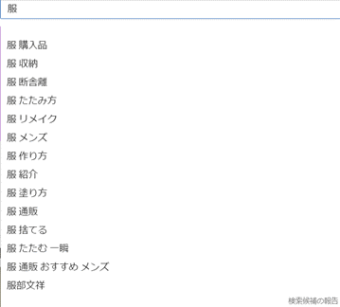
For example, simply typing “clothes” brings up various terms such as “clothes haul” and “clothes storage.”
In other words, it seems there are concerns like “I’m not sure what clothes to buy” and “I’m struggling with storage.”
We also recommend actually searching and using videos with high engagement (likes and comments) as references.
Reason #4: The filming environment is not properly set up
This is an area people tend to cut corners on.
However, what is extremely important is the “filming environment.”
Compared with defining the channel’s direction and planning videos, it tends to be underestimated, but simply setting up the filming environment properly can dramatically improve video quality.

When you watch videos as a viewer, would you want to watch a video that is “full of noise,” “shaky,” and “so quiet you can’t understand what is being said”?
Like you, many viewers are likely to stop watching quickly if a video is hard to hear or see, even if the concept is interesting and the presenter is appealing.
The three main points when setting up your filming environment are “audio, camera position, and brightness.”
First, do a test shoot and film while paying attention to the following items.
[Audio]
・Film in an environment where you can eliminate external noise such as air conditioner airflow and passing cars
・Speak at a volume that is easy for viewers to hear
[Camera position]
・If filming from a fixed position, use a tripod to secure the camera firmly
・If filming while moving the camera, use a camera or stand with image stabilization to prevent screen shake
・Adjust the shooting position so the camera lens is level with your eye line
[Brightness]
・Check that sunlight or lighting is not too strong, causing the screen or the presenter’s face to be overexposed, and that it is not creating shadows instead
・If it is not bright enough, adjust by using a light such as a ring light
Reason #5: You are not creating titles that capture the key points
Do not underestimate titles!
The YouTube home page (the first page that appears when you open the YouTube app) is like a “department store” where an enormous number of videos flow by.
Unless you give your video an eye-catching title that succinctly summarizes the key points and makes people want to watch, it will not stand out to viewers among countless videos.

[Key Points for Creating Titles]
1.Spark viewers’ interest
2. Optimize for the YouTube search engine
1.Spark viewers’ interest
If the YouTube home page is a department store, the title is like attractive packaging or a POP display.
It plays a crucial role when customers who stop by casually think, “Which one should I pick up?” among countless items. There are several common patterns for titles that are more likely to capture viewers’ interest.
While keeping in mind that the title should succinctly represent the content, it is effective to think of titles by fitting them into representative formats like the ones below.
・“Warning” format…A title that evokes a negative image and creates a sense of urgency.
Example: “Bad habits you should never do,” “10 behaviors incompetent people do unconsciously”
・“Ideal outcome” format…A title that suggests a way to get closer to the viewer’s ideal self.
Example: “3 miracle items to clear acne by tomorrow,” “10 behaviors women who are loved by everyone practice”
・“Problem-solving” format…A title that hints at a solution to the viewer’s concerns.
Example: “[For those whose makeup breaks down easily] Are you choosing primer by the packaging?” “Introducing a skincare routine that dramatically improved mask irritation”
2.Optimize for the YouTube search engine
Using the department store analogy, this is like giving your shelf more space to make it easier to find, or having staff remember it and recommend it during customer service.
When optimizing for the search engine, the keywords you should include in the title generally fall into the following two categories:
・Keywords viewers are likely to use when searching for videos
・Keywords used in titles by channels that cover similar genres
Creating titles using such keywords enables SEO measures within YouTube.
Specifically, it provides benefits in the following areas:
■Higher ranking in search results……When viewers search on YouTube, your video is more likely to appear near the top
■Appearance in related videos……Your video is more likely to appear in recommended videos shown while viewers are watching other videos
Because these play a very significant role in increasing views, optimizing for the search engine ultimately makes your videos easier to watch (we also introduced how to use the YouTube search bar earlier in this article!).
Even while keeping the above points in mind, there is something you must be careful about when creating titles.
That is including keywords that do not match the video content or using an excessively exaggerated title.
Example)
[Excessively exaggerated titles]
“From tomorrow, anyone can definitely become a person who earns money!” “If you eat only this, you will definitely lose weight!”
[Keywords that do not match the video content]
“~Important announcement~ Suddenly, I’m quitting YouTube”
→In reality, it was an announcement that they were not quitting, but would stop posting long videos and start posting Shorts instead.
To grow subscribers and achieve stable views on YouTube, it is essential to create a positive impression, earn trust, and increase engagement.
Titles that do not match the content or are overly exaggerated end up deceiving viewers and reducing trust. Therefore, while ensuring there is no mismatch between content and title as a basic premise, create titles that are concise and impactful.
Reason #6: There is no effort to keep viewers engaged
When evaluating video performance, it is easy to focus on metrics such as subscriber count and views, but there is another analysis metric that is just as important.
That is “audience retention.”
“Audience retention” is a metric that indicates how long viewers continued watching a video. YouTube has an algorithm that tries to show high-quality videos that attract viewers to as many people as possible, increasing their exposure.
In other words, to increase video views and channel subscribers,the key is to keep viewers from getting bored midway and have them watch as close to the end as possible.

To improve audience retention, incorporate the following kinds of ideas in planning, filming, and editing to create videos that “keep viewers hooked.”
・Rather than talking on and on, summarize key points (e.g., “There are three points”) and clarify what you will talk about.
・Within the first five seconds, hint at the core of the main content and set up a hook that makes viewers want to watch.
・Cut pauses in speech during editing to create a tight, well-paced video.
・Create visual variety by filming with multiple cameras or changing angles and scenes.
After uploading a video, be sure to use YouTube Analytics, YouTube’s analysis tool, to check audience retention numerically and review how well you were able to sustain viewers’ interest.
In YouTube Analytics, you can visualize in a graph at what point viewers stopped watching. Based on this data, consider improvements and apply them to your next video.
Example:
“In this video, as many as 40% of viewers dropped off at the beginning… The introduction was too long, so in the next video, let’s try shortening the intro by 30 seconds.”
“Viewership drops sharply while explaining the third point… Maybe it was too generic to be helpful. Let’s check how competing channels explained a similar theme.”
Once you get used to it, it is also interesting to combine it with other metrics such as “thumbnail click-through rate” and “subscriber growth/decline rate.”
How was it?
At SUNNY SIDE UP, we also have a team specializing in social media operations in addition to PR, and we plan to share information on how to leverage each platform going forward. Please look forward to it!