What are effective PR strategies that combine SDGs and social action? A report on reading SSU Group’s new book, “SDGs for Companies to Thrive in 2030,” from a Gen Z perspective
Hello! I am Iguchi from the Social Good Promotion Office (*), SUNNY SIDE UP GROUP.
You have probably been hearing the terms SDGs and Social Good more often lately. They are also gaining traction on social media, and these days it feels like there are many topics that start with “S.”
*For details about the Social Good Promotion Office, click here.
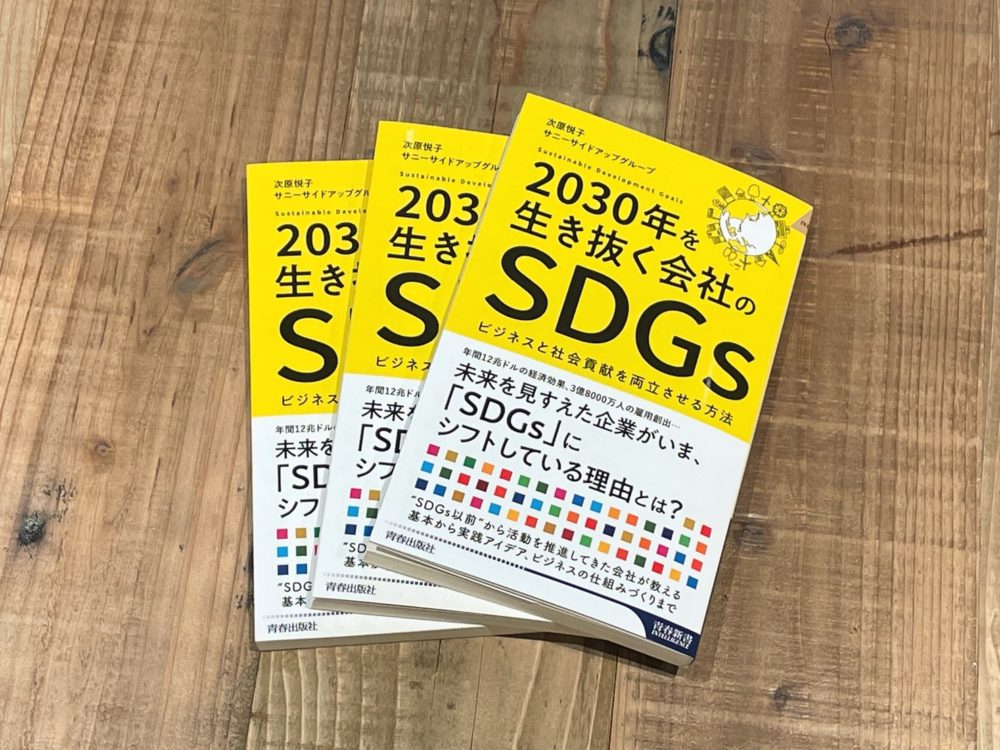
Against this backdrop, SUNNY SIDE UP GROUP has published a new book with #SDGs and #SocialGood—keywords that matter for the future of the planet, Japan, companies, the important people around us, and ourselves: “SDGs for Companies to Thrive in 2030”!
It was officially released on Friday, July 2, 2021.
In this blog post, I would like to introduce the book, along with my impressions from a Gen Z perspective (*) after reading it ahead of time, plus a bit of my own analysis.
*Gen Z generally refers to those born from the late 1990s to the early 2000s. As digital natives and social natives, they are also said to be a generation with new values.
Background to the publication >>>
In fact, at SUNNY SIDE UP GROUP, we have been involved in numerous social action initiatives since the era of the MDGs (Millennium Development Goals: eight international goals compiled in 2001 with a target date of 2015)—long, long before the SDGs (Sustainable Development Goals) were adopted.
For example, the “White Band Project,” which sparked a movement of people stylishly wearing white wristbands together and supported global advocacy efforts to eradicate poverty.
There is also “RockCorps,” a live event where participants can experience music performances by top artists by taking part in four hours of socially friendly actions such as picking up litter, and more.
This book is also ideal for those who are unsure how to approach SDGs as a company, as well as those who want to learn about the differences in social impact between “donations” and “awareness-raising,” and how to maximize external communication power for internal SDGs promotion activities.
It also serves as an easy-to-use manual for in-house teams and seminars, clearly unpacking case studies and condensing over 30 years of “social action” PR know-how into a single volume.
Book overview >>>
Title: SDGs for Companies to Thrive in 2030
Author: Etsuko Tsugihara / SUNNY SIDE UP GROUP
Release date: Friday, July 2, 2021
Price: ¥1,020 (excluding tax)
Length: 224 pages (shinsho format)
Publisher: Seishun Shinsho
Amazon page: https://www.amazon.co.jp/gp/product/4413046242
Table of contents
Chapter 1: “SDGs Super Basics” for people and companies living in the years ahead
Chapter 2: Poverty, discrimination, environmental issues… no longer someone else’s problem
Chapter 3: Why future-oriented companies are shifting to “SDGs”
Chapter 4: “Social good” initiatives undertaken even before “SDGs”
Chapter 5: “Small mechanisms” and “practical ideas” to balance with business
Chapter 6: Communication is 90%! How to effectively promote SDGs initiatives through PR
[Appendix] The SDGs “17 Goals” and “169 Targets” with a deadline of 2030
Age 23, female, Gender Studies major: Impressions that made me go “Oh!” after reading it as a Gen Z reader >>>
I have been speaking rather formally up to this point, but I myself am Gen Z and have only just started thinking casually, “SDGs may seem difficult, but if we could engage with them in a more interesting and enjoyable way, both humanity and the planet would be happier.”
I will share my thoughts in a relaxed way, focusing on points that students currently job hunting—especially those interested in ethical job hunting and diversity inclusion—may also relate to.
*I was born in 1997 and joined the company as a 2020 graduate, so even within the diverse Gen Z, there may still be a generation gap. I look forward to receiving many reviews.
★We do not waste money swayed by trends hyped up by the mass media.
┗As smartphone natives, we have learned media literacy even in compulsory education. Rather than that, we want to spend money on things and experiences we genuinely think are good—social-good actions. It is the same as supporting your favorite.
Up through middle school, my relationship with mass media was like this: “It felt like fewer than half of households subscribed to a newspaper,” “I might buy a magazine when my favorite celebrity is on the cover or featured, but basically I only read them at the hair salon,” and “I made a radio for an art class emergency assignment, but it stayed tucked away behind the sliding doors.” *I used a flip phone until middle school.
Until around high school, I was busy with studying for tests, extracurricular activities, and part-time work, so I only glanced at the news on my phone. When I got home, I would see delicious-looking food featured in the evening news on the TV that was barely on and think, “Looks so good (Tokyo is too far to go lol: even I, living in Kanagawa, had a narrow range of movement in the late Heisei era),” or watch nighttime variety shows featuring trendy spots and think, “Oh, I want to go (but I have neither the time nor the savings, and I cannot skip club activities lol).”
From college onward, my daily rhythm changed completely, and I began to get information mainly from social media and web reviews rather than TV—and to spend money accordingly.
I think one major reason is that places influencers or friends mention on social media, or mouthwatering food spots, feel more credible and are closer to my usual range, making them easier to visit. Looking back, even though friends living alone had TVs, they mainly used them for games or YouTube, and very few people actually watched trend programs or the news.
This may be a slight digression, but after becoming a working adult, there have been more and more times when I cannot even relate to what I see on social media.
For example, I sometimes press “Like” (♡ empathy) on Twitter when: ・I genuinely think something is wonderful
・I think, “This is awful! What is this?!”
・Sometimes even when I see an obituary and think, “My condolences.”
Is that really a true “Like”? I believe noticing this is also part of Gen Z values.
Rather than liking bad news and drawing attention to it,
・sometimes we report it to prevent it from spreading
・we do not click because we do not want to contribute to view counts
・or, conversely, we may confront it head-on in the comments…
In that sense, I personally feel we have entered a phase of reconsidering what genuine empathy really means.
In the meantime, as an action to express “Like” outside of social media, I also feel that spending money in the form of “buying something = supporting/endorsing that brand” has certainly increased.
(However, not many people are that well-off, so as a student, I can only do it when I am not barely scraping by on part-time work. And honestly, I also feel that as a new working adult, you cannot live with that much financial leeway.)
It is the same with supporting your favorite. Because you want your “oshi”—a GOOD, or rather GOD-like presence who lights up your world—to live healthily, brilliantly, and sustainably, you watch lots of videos, buy an insane amount of merchandise, and participate in events with everything you have.
In this way, I think more young people would want to make society (and people) better little by little through familiar actions, rather than appealing through force such as demonstrations or petitions—if not for the issue of poverty.
★For young people, salary is not the only motivation to work.
┗Yes. Absolutely. We choose workplaces based on how much we can contribute to society, how much we can help others, and whether we are recognized as an individual—including gender identity.
One reason I chose SUNNY SIDE UP was that I job hunted with the perspective of, “If a PR company that thinks about cutting-edge ideas and trends feels outdated in its values, is it not already over?”
Fortunately, SUNNY SIDE UP develops its business with social action at its core, has no gender field on resumes, and listened to me not as “male or female,” but as one person—about how I want to live and work, from a perspective beyond salary alone.
At companies where I sensed a culture of “promotion! raises! meritocracy and overthrowing the hierarchy!” I picked up on an atmosphere of “a man’s world + women should be tough too!” and wondered whether that was truly gender-equal… so I was a little scared and declined. I am sorry.
I remember thinking, perhaps cheekily, that in Japan—where the gender gap index is high—there should be more companies that are kind to both men and women.
★The key to SDGs success is “together, with everyone.” This “with everyone” also brings to mind the SDGs’ shared principle of “leave no one behind.”
┗“Work on it together, and benefit together”—this spirit is GOOD!
Among Gen Z, a sense of self-affirmation—“Just being alive is admirable, and just being alive is wonderful!”—is becoming a kind of status.
And to expand that into values of being kind to yourself + kind to the person next to you + kind to everyone, we share SDGs and social-good ideas with one another and praise each other. Personally, I feel we need the power of PR to create a sustainable, kinder world.
That is all—this became far too long, but what did you think? I am not good at writing book reports, so I tried to speak more candidly. I would be happy if it made you want to read the book, even just a little.
Finally.
It went into a second printing just 10 days after sales began in April 2021, and achieved a triple crown in the following categories:
Amazon.co.jp Best Sellers Rank: Books
・No. 1 in Advertising Promotion
・No. 1 in Marketing Sales (General)
・No. 1 in Small Business Management (as of 2021/04/30)
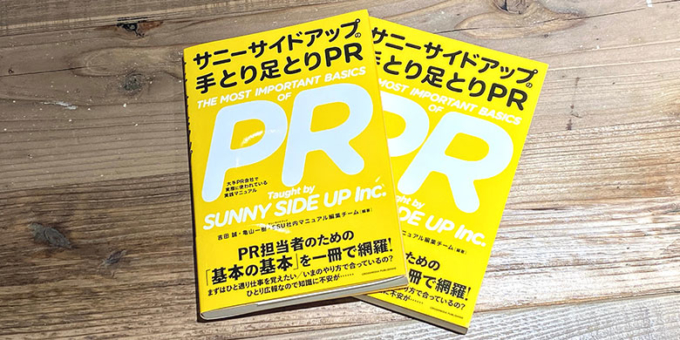
The in-house manual exposé book, “SUNNY SIDE UP’s Step-by-Step PR”!
I also received a lot of feedback from friends saying, “I saw the yellow book in stores!”
Read the article reporting on the behind-the-scenes of producing “SUNNY SIDE UP’s Step-by-Step PR” here:
Releasing our in-house manual!? Our manual book packed with almost everything about SUNNY SIDE UP’s work, “SUNNY SIDE UP’s Step-by-Step PR,” is out now!
https://blog.ssu.co.jp/pr_methods/19483/
Please be sure to check this out as well.
Author of this article
President’s Office, Social Good Promotion Office
SDGs MAGAZINE Editorial Team
Arisa Iguchi
After graduating from the School of Global Studies and Cultural Policy at Aoyama Gakuin University, she joined SUNNY SIDE UP as a new graduate and is now in her second year. As a media promoter, she loves social media so much that she also joined the in-house media editorial team. While curating articles, she fell deep into the SDGs rabbit hole, and eventually even joined the newly established Social Good Promotion Office within the President’s Office. Her favorite color is green. The green she dislikes is the praying mantis.