From planning to sales: the other side of SUNNY SIDE UP—our “manufacturing” team. “It’s tough, but the happy moments are about twice as many.”
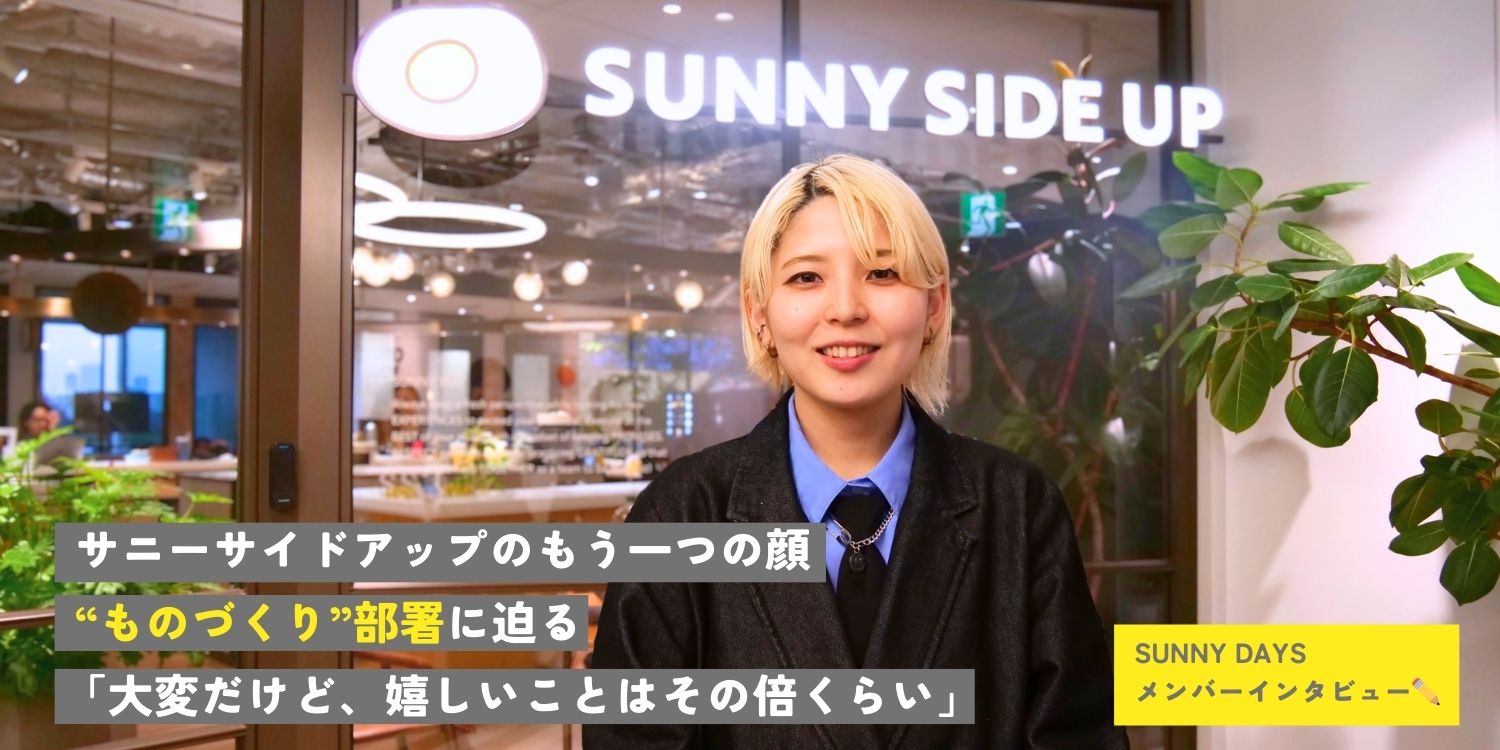
As a PR agency, SUNNY SIDE UP provides PR support and consulting to help promote people, products, experiences, and more to the public.
Did you know that SUNNY SIDE UP also has a team dedicated to “manufacturing”? Led by Happy Kuji, we develop products sold at convenience stores and mass retailers—so some of you have probably thought, “I’ve bought that!”
This time, we introduce SUNNY SIDE UP’s little-known manufacturing team. We spoke with members of Division 6—one of our manufacturing teams—about what makes the work rewarding, lessons from failures, and the kinds of people who work there.
Before I joined SUNNY: “I was a kid who loved TV and entertainment.”
I was originally a child who loved TV and entertainment. I have always been curious and quick to jump on trends and anything that caught my eye. I especially loved television, so I wanted to be on the production side and joined a TV production company as a new graduate, working as an assistant director (AD).
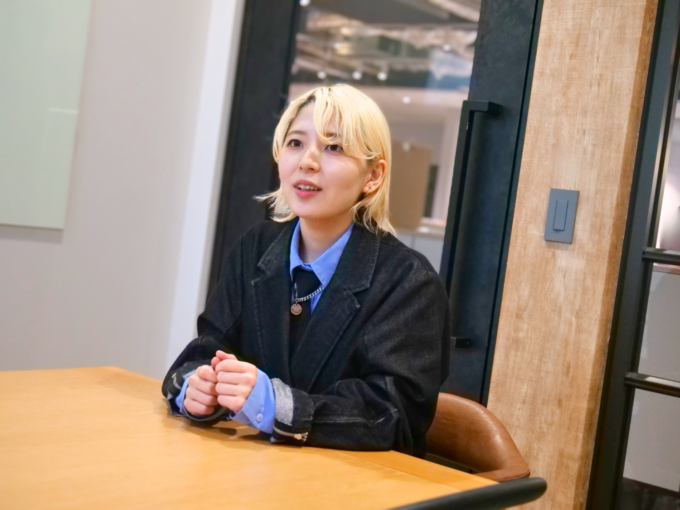
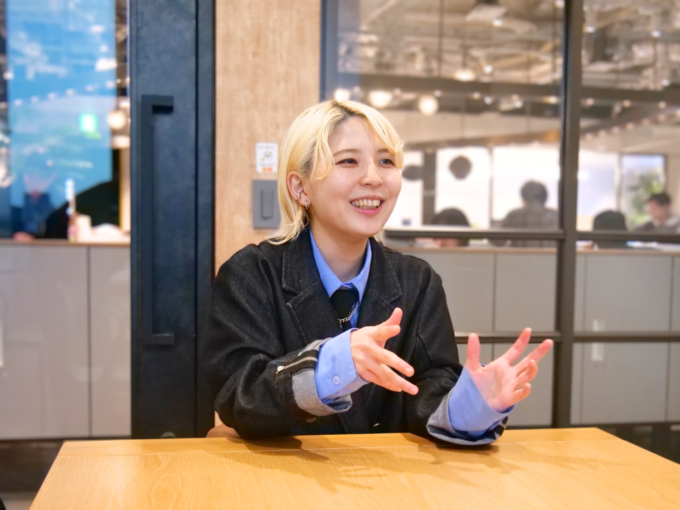
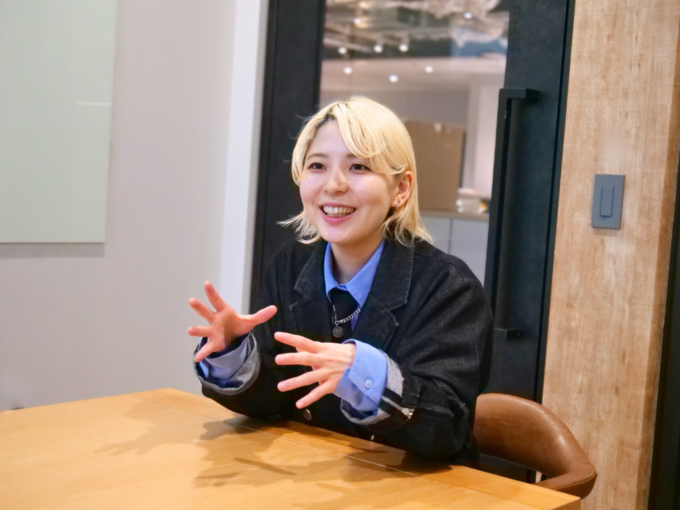
Public Relations Business Headquarters / Division 6 / Department 1 / Group 1 Minori Yoshida (よしだ みのり) Mainly in charge of MD (production management). Recently into Japanese and Korean idol groups. I have the grit of an AD!
I joined the company full of expectations, but the people in TV production were all brilliant, idea-driven types. At the time, I keenly felt my lack of planning ability.
So I thought there might be another way for me to be involved in entertainment outside the TV industry, and I changed jobs to a web media company. It ran its own media platforms, and you could create projects from scratch.
I believe the creativity I couldn’t fully develop in my previous job was cultivated there. I gained extensive hands-on experience across a wide range of work—planning, interviewing, writing, and PR. Unlike being an AD, where tasks were divided, it was tough to handle everything on my own, but it was a great opportunity for growth. I became faster at work and more resilient when given unreasonable requests (laughs).
Then the pandemic hit… PR-related work was postponed across the board, and with stay-at-home measures, I suddenly had time alone—time to think about my future. Combined with my natural curiosity, my desire to try something in a different industry grew, and I decided to reassess my career. Around that time, an AD senior who had moved to SUNNY SIDE UP invited me, which is what first made me consider the company.
Even after I left, I went out for drinks with that senior many times and heard what SUNNY SIDE UP was like, so I had long thought it sounded very enjoyable, including the work itself and the company atmosphere. Incidentally, that senior is Kondo, who is now my manager.
Even within SUNNY SIDE UP, is Division 6’s work really that different? “We handle everything from planning and manufacturing to sales, all from scratch.”
In Division 6, where I belong, we mainly focus on “manufacturing.” We plan from scratch and handle everything in a one-stop process all the way through production and sales.
Specifically, this includes lottery products such as “Happy Kuji” sold at convenience stores and mass retailers, as well as collaboration items with artists sold at events.
In terms of the process up to sales, we might plan a collaboration product to coincide with a character’s anniversary year, obtain permission from the IP (intellectual property) rights holder, then approach an artist, turn the artwork they create into a product, and sell it. We also handle OEM products (manufacturing products for other companies’ brands).
It depends on the project, but in general it takes around six months from planning to sales. Some can move forward in as little as about two months. Because there is a physical product, the cost of goods is significant, and the way we think about costs—especially on the sales side—may be very different from other departments.
Products are not only manufactured domestically; in some cases they are produced at overseas factories such as in China. In those cases, we basically use translation apps to communicate. I believe this kind of communication works because of the relationships our seniors have built over the years.
We also have members in-house who are strong in languages, including people from China, so while language skills are certainly helpful, not having them does not hinder the work.
More important than language ability is the ability to steadily drive work forward through delivery. When it comes to schedules from manufacturing to delivery, there are many parts that simply cannot be shortened, so the only option is to push forward while managing timelines strictly. Manufacturing takes X days, shipping takes Y days… there is time that will definitely be required no matter how much people rush.
Manufacturing work “requires initiative and a strong sense of responsibility.”
The MD (merchandising) work I am involved in is very different from typical PR work.
To keep the various steps that inevitably arise in making products on schedule, initiative and a strong sense of responsibility are essential. If you miss the schedule, it becomes an incident; if there are defects, that is also an incident. You are always right next to potential incidents.
That is why it is important to plan procedures carefully and move forward with a strong sense of responsibility. Even so, this job suits people who can face the obstacles they encounter without being discouraged. It is important to take initiative yourself in order to break through those barriers.
In my case, the grit and sense of responsibility I developed as an AD have been extremely helpful.
In the TV industry, from the top of the production team to the most junior staff, everyone shares the same understanding: “Never cause a broadcast incident.” No one thinks it is okay if things are not ready in time. That shared sense of responsibility still remains with me today.
If I were to add what else is needed for this job, it would be communication skills and approachability.
Other than that, there is nothing like “this alone is enough.” Having a special skill may increase the work you are asked to do, but it does not necessarily mean you will always succeed. And even if there is something you cannot do, you can simply learn and become able to do it. So I believe what is needed is the drive to communicate proactively with team members and clients and to keep growing in a positive way.
Personally, if something catches my attention, I immediately look it up and go see it—I am quick on my feet when it comes to information. That is true both in my private life and at work. I think my broad interest in many things is also put to good use in my work.
What you can do because it is SUNNY SIDE UP: “There are people who tell you it is okay to take on challenges.”
On a personal note,there are many people around me who tell me it is okay to take on new challenges.That atmosphere existsbecause so many people have taken on new challenges before, and those efforts have accumulated over time.
In the past, even when I wanted to take on a challenge, I often ended up stuck while thinking, “Will this really work?” “Can I get approval?” “I should research a bit more.”
But at SUNNY SIDE UP, there are people who positively frame things and give advice like, “Wouldn’t it work if we do it this way?” and there are also managers who think, “With this kind of budget, you can take on the challenge.” Because of that, being able to actually move forward as a project—thinking, “Then let’s go talk to them,” “Let’s set up an appointment”—is something I feel is quite remarkable.
A sense of fulfillment beyond the struggle: “Seeing people happy is detox.”
For one project, in addition to the product itself, we decided to create a commemorative item for the talent who served as the project’s ambassador.
The schedule was extremely tight, and it was only completed two days before the commemorative event. But when we looked at the finished item, it differed from the original specifications. It was a difference you could hardly notice at a glance, but honestly, I thought it was over.
Should we explain the situation to the client and ask for their understanding, or have the factory remake it…?
There was no time, and I thought we should explain it to the client, so I consulted my manager.
“Negotiate with the factory and have it remade, no matter what.” That was the answer. The order details were not wrong, and there was no reason the client should have to accept something incorrect. Those words made me reconsider what responsibility I needed to bear and what action I should take, and I learned a great deal.
Nearly in tears, I spoke with the factory and asked them to change the manufacturing method so we could somehow move forward, but it would be finished the night before. In heavy rain, I rushed the completed item to the client’s office. I remember my hands shaking when I delivered it.
The event was also streamed, and the commemorative item that we somehow delivered in time made the ambassador truly happy. Fans who saw it responded with comments like “It’s so cute” and “I want to copy it,” and some even made their own… When I witnessed that, all the hardship up to that point disappeared like bubbles. It was total detox (laughs).
The moment something you planned becomes a product, reaches people’s hands, and you can see reactions in stores, on social media, and across various media—no matter how many times I experience it, I find it rewarding. Being able to see the end recipients also gives me energy for my work.
What I want to challenge myself with next: “So I can share the appeal of manufacturing with junior colleagues.”
My work today is made possible with the cooperation of many people, so I want to gradually reduce the parts where I rely entirely on others and become able to handle things independently.
I want to keep improving my own skills, and when I have junior colleagues in the future, I want to work hard so I can convey as much as possible of the appeal of manufacturing to them.
And not only external clients, but also internal members—when manufacturing is needed, such as “It would be great to have something like this for an event,” I would like them to consult us more and more. We also now have an online sales page for “Happy Kuji,” so I believe we can think together about sales channels for the products we create.
Manufacturing work involves many tough moments, but there are about twice as many happy moments—an incredible number of them.
If you want to overcome adversity and accomplish something big, please come work with us. We look forward to your application!