A Soccer Fan Explains the Trending Topic of NFTs Using Professional Sports Team Examples | SSU Digital Lab Vol. 2
Hello!
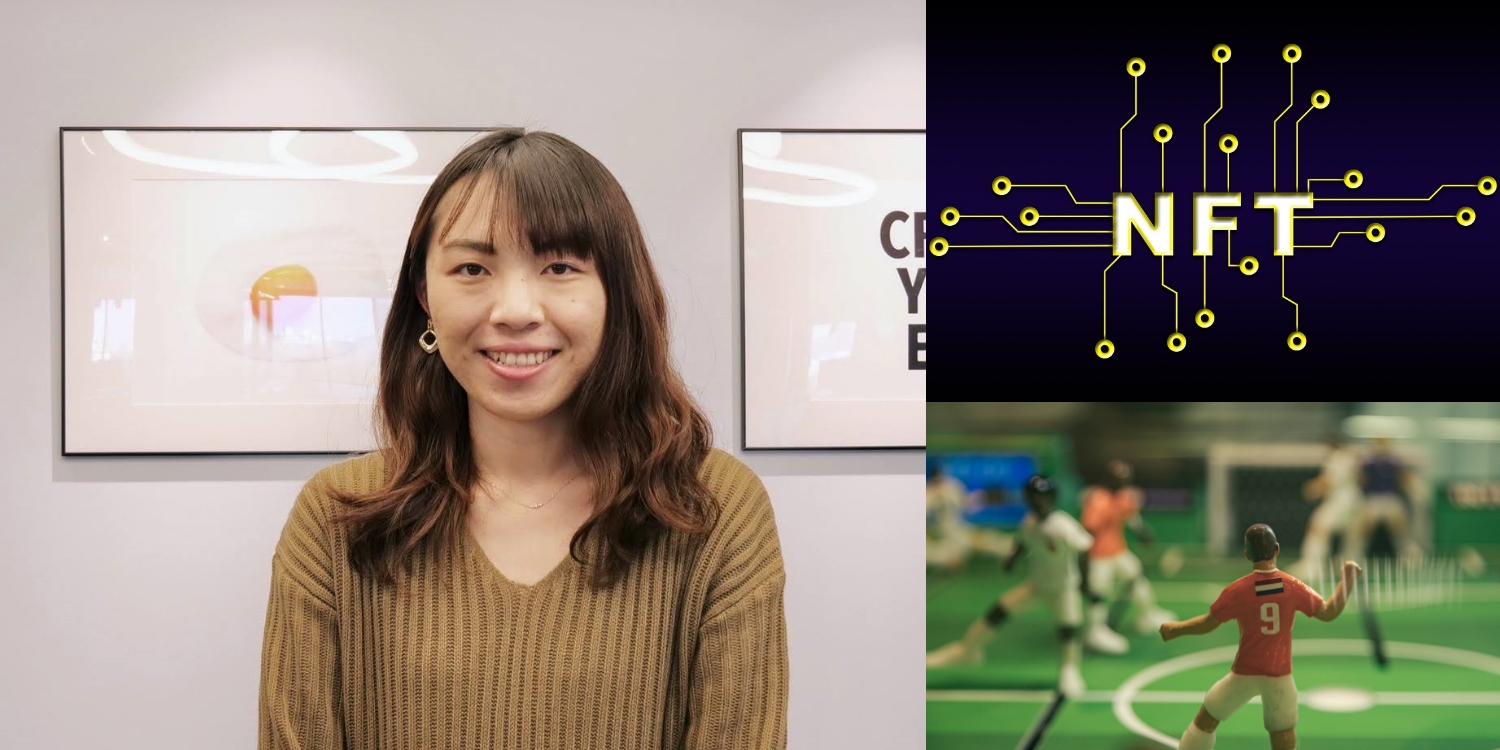
I am Abe from the 2nd Division of the SUNNY SIDE UP Public Relations Business Headquarters.
Recently, we have been hearing unfamiliar terms like “NFT,” “token,” and “blockchain” quite frequently. With so many complex technical terms, many people likely find it difficult to keep up with the conversation.
We see more and more NFT-related news, such as a third-grade boy’s summer research project drawing being traded for approximately 2 million yen. I try to look into it myself from time to time, but I still find it difficult to understand why such things gain so much value…
Therefore, I decided to try to understand NFTs by looking at them through the lens of something I love. Using examples from the J.League, which is celebrating its 30th anniversary this season, I would like to deepen our understanding together with the readers of SUNNY DAYS!
■ What is an NFT in the first place?
NFT stands for Non-Fungible Token. In Japanese, this translates to “hi-daitaisei (irreplaceable) token.” It sounds confusing already, doesn’t it?
A token refers to a digital asset. By attaching an irreplaceable proof to digital data to show that the data is one-of-a-kind, asset value is created. Because it is no longer possible to copy or tamper with the data, NFTs have made it possible to give value to digital data.
This is a brief explanation, but since the world is already overflowing with information on “what NFTs are,” I encourage those who wish to learn more to look it up.
Now, let me introduce examples of J.League clubs that are developing businesses using this system!

■ Shonan Bellmare: The first domestic J.League club to introduce Fan Tokens
In January 2021, Shonan Bellmare took the lead among domestic J.League clubs by introducing fan tokens. They signed an official partnership agreement with a company providing NFT services using blockchain technology and began issuing club tokens.
Here are the initiatives started by Shonan Bellmare:
1. Issuance of the first club tokens by a domestic J.League club
2. Club token-based funding
The club tokens in (1) are digital items that serve as proof of support for Shonan Bellmare, and the club token-based funding in (2) is a fundraising mechanism utilizing those club tokens.
The proceeds from tokens purchased by supporters are used for team and event operations. Furthermore, token holders receive special experiences, such as the right to participate in “Special Day” events and voting projects, or to apply for limited-edition goods. This allows them to support the club’s management while directly assisting the team.
It is slightly different from a fan club or a booster association; it is a way to support club operations more directly. It could truly be called a new form of support for the digital age.
■ Matching with the Brand Message
Are you familiar with the J.League’s slogan?
It is the “J.League 100-Year Vision.” The J.League also places great importance on the concept of being a “community-rooted sports club” and on activities to promote sports culture centered around that idea.
There are currently 58 J.League clubs (as of 2022), and I believe that a system allowing people to directly support the clubs they feel an affinity for in their own regions is a symbolic movement that matches these concepts.
From a PR and branding perspective, it is important not to use NFTs or tokens just because they are trendy, but to launch measures that align with the brand’s message and slogan.
In my opinion, people who love sports and have a team they support are vital supporters who possess the loyalty to “support their beloved club no matter what,” even if the team’s performance is not great.
Triggered by Shonan Bellmare’s challenge to incorporate club support tools in a new form for such people, the number of J.League clubs introducing the same system has increased one after another, including Avispa Fukuoka, Thespakusatsu Gunma, and Y.S.C.C. I expect that the entry of big clubs will continue to increase and make things even more exciting.
※ As a side note, I highly recommend the book “Tanoshi-meteru-ka: Shonan Bellmare 2016 Front no Tatakai” (Authors: Naohito Mizutani, Tatsu Ikeda), so please give it a read, especially if you like sports! It is a collection of fascinating stories about the efforts made by a single J.League team to build a community-rooted club.
■ Urawa Reds to enter the NFT business
In January 2022, Urawa Reds also entered the NFT business by forming a partnership with MINKABU THE INFONOID, Inc. (hereinafter referred to as “Minkabu”). They announced that they would sell NFT content for fans.
The plan is to provide digital content within a dedicated community—such as memorial videos, audio, and photos—that only a limited number of fans can obtain in restricted quantities.
A feature of the NFT platform provided by Urawa Reds and Minkabu is that content can be purchased even without a crypto asset wallet (something like a digital wallet required for transactions).
They are also reportedly developing a function that links with online shop products and in-store goods, allowing people who purchase specific items to obtain NFT cards via QR codes.
We are truly in an era where everything is connected by data.
■ DAZN and mixi to launch “DAZN MOMENTS,” a sports-specific NFT marketplace, this spring
DAZN, the sports channel that also holds broadcasting rights for the J.League, and mixi, which operates communication service businesses, have announced the launch of “DAZN MOMENTS.” This is a sports-specific NFT marketplace that provides super plays and memorial scenes from various sports as NFT content with serial numbers.
While the official launch date and detailed content have not yet been announced, the service is being built on the next-generation blockchain “Flow.” They plan to update it into a service where users with the same interests can enjoy communicating with each other, gradually adding marketplace functions for users to buy and sell content and creating spaces for the community to gather.
The J.League signed a 12-year broadcasting rights agreement with DAZN from 2017 to 2028 for approximately 223.9 billion yen. Now, goal scenes and player footage can be easily viewed on social media, including Twitter timelines.
I would like to keep an eye on what kind of service DAZN’s sports-specific NFT service will be, as it handles J.League matches, Japan national team games, overseas soccer, and many other sports besides soccer.
I have focused entirely on soccer this time, but the sports world is currently in the midst of an “NFT festival,” with six Pacific League professional baseball teams entering the NFT business in collaboration with Pacific League Marketing Corp. and Mercari, Inc. We cannot take our eyes off future developments!

■ In closing
Finally, I felt that when you research something you find difficult through the lens of something you like, the information sinks in much more easily than expected (laughs).
If you are not fond of technical terms but want to keep up with trends, please try researching NFT businesses in your favorite fields or genres! Thank you for reading until the end!