“Not knowing” was the biggest barrier—Voices from the Class of 2025 on LGBTQ+: A discussion reflecting on Ms. Sugiyama’s lecture

Nice to meet you. We are Takeuchi and Nagumo from Social Relations Division 2, and we joined the company in April 2025.
This may be sudden, but are you familiar with the term “Ally”?
An “Ally” is someone who understands and supports sexual minorities, such as those represented by LGBTQ+. In recent years, there has been a growing movement across society to deepen understanding of diverse gender identities and sexual orientations; however, many people may still find it difficult to see it as something that relates to them personally.
At SUNNY SIDE UP GROUP, PR communications are at the core of our business, and we have worked to create social movements and address social issues. For that reason, we believe that having accurate knowledge and empathy toward diverse people is also a responsibility to society. Based on this belief, we set aside time as part of our new-employee training to learn about diversity.
This time, we invited Ms. Fumino Sugiyama, CEO of New Canvas Inc. and Co-Representative Director of the NPO Tokyo Rainbow Pride, to give a lecture for our newly hired graduate recruits.
Learning from transgender individual Fumino Sugiyama: What does a society where everyone can live comfortably look like?
As a transgender individual, Ms. Sugiyama shares her experiences while engaging in a wide range of LGBTQ+ awareness-raising activities. In addition to being involved in the establishment of Shibuya Ward’s same-sex partnership system—the first of its kind in Japan—she also gives lectures nationwide and appears in the media.
Her new family style—raising two children as three parents together with her partner and a friend who is the sperm donor—has also drawn attention. She currently also serves as a Director of the Japan Fencing Federation and a Director of the Japanese Olympic Committee, among other roles.

The lecture began by outlining the current situation, including the fact that Japan ranked 118th out of 146 countries in the Gender Gap Index published by the World Economic Forum in 2024, highlighting that Japan is lagging behind globally in LGBTQ+ support.
Through Ms. Sugiyama’s life story, she spoke about the many conflicts she has felt between society’s “norms” and her own gender. From a young age, she experienced discomfort with her body and distress at having to wear a sailor-style school uniform. Faced with the unimaginable anguish of someone directly affected, all of the newly hired members listened intently to her story.
During the lecture, Ms. Sugiyama introduced the concept of “Welcoming Out” as a concrete action allies can take.
This is the idea that allies actively create a safe environment by showing understanding and a welcoming attitude, so that individuals can choose for themselves whether or not to come out. Rather than “waiting” for someone to come out, conveying messages such as “I want to know more about you” and “You can talk anytime” helps create an environment where individuals can feel safe and at ease.
This lecture provided a valuable opportunity for each participant to reflect personally on how being in a state of “not knowing” can lead to “unconscious bias.”
Ms. Sugiyama, thank you very much for providing us with so many learnings and insights.
▼Click here to see our in-house seminar for International Men’s Day, where we learned about “unconscious bias.”
How did the newly hired members actually feel about Ms. Sugiyama’s lecture? What differences are there in social awareness and the surrounding environment between when Ms. Sugiyama was a student and today, for members of the Class of 2025 (born in 2002) who have grown up with the education of the present day?
We will explore in depth, in a discussion format based on real experiences, the gap between the society Ms. Sugiyama described through her own life story at the timeand the present day as experienced by the newly hired members.
A discussion with the newly hired members after the lecture
Meet the participants
|
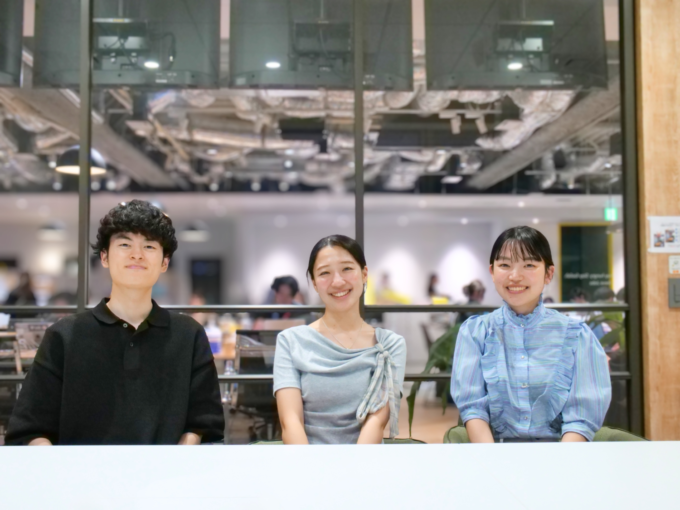
Miku Nakamura: Right in the photo. Because she attended a women’s university, she had many opportunities to learn about women’s careers and the gender gap. Also, one of her professors came out as gay, and LGBTQ+ felt familiar to her from her university days, which is why she participated. Kota Takeuchi: Left in the photo. He had not previously had opportunities to think about LGBTQ+ and had not taken much interest. After learning about the current state of LGBTQ+ issues through Ms. Sugiyama’s lecture, he became interested and decided to participate. Yuna Seki: Center in the photo. Having studied abroad in Canada three times in total, she had many LGBTQ+ friends around her. With extensive global experience, she had felt a sense of discomfort about the differences between Japan and Canada in gender-related education and awareness, which is why she participated. |
Q. What stood out to you most from Ms. Sugiyama’s talk?
– In Ms. Sugiyama’s lecture, she shared episodes from her own experience of dating a woman in high school, including how LGBTQ+ was perceived in society at the time and the difficulties she faced in her relationship with teachers. We asked the participants how they feel public attitudes and “common sense” have changed since the time when Ms. Sugiyama was a student.
Seki: I still feel there is prejudice towardLGBTQ+. I have lesbian and bisexual friends, and they also find it hard to come out… While Canada has a culture that respects “living true to yourself,” I feel that in Japan, there is a stronger tendency to prioritize “fitting in with those around you.”
However, I do feel that the atmosphere of “it’s not good to come out about your identity, includingLGBTQ+” has improved compared to the past!
Nakamura: I was especially struck by Ms. Sugiyama’s story about “not liking uniform skirts.” Even when we were students, it was still common that you couldn’t choose between a skirt and trousers for school uniforms.
Takeuchi: I haven’t been abroad, so I didn’t have anything to compare it to, and I never thought discrimination still existed in Japan. But Ms. Sugiyama’s experiences were truly painful to hear.
Seki: That’s absolutely true. We’re all human—there’s no such thing as “you’re not allowed to fall in love.”
– Based on each person’s experiences, we can see that while public attitudes and “common sense” around LGBTQ+ have improved compared to when Ms. Sugiyama was a student, there are still factors that make life difficult, such as how easy it is to come out and issues like uniform skirts. With this reality in mind, what did the students who attended Ms. Sugiyama’s lecture feel, and how did their perspectives change?
Q. Did the lecture change the way you think?
Nakamura: I felt the warm relationship between Ms. Sugiyama, her partner, and their children was truly wonderful. While legal issues remain, I personally hope society’s understanding will expand to include family structures like this as one form of diverse families.

Takeuchi: Hearing Ms. Sugiyama say that “the way someone experiences gender isn’t visible,” and believing that everyone in the world deserves to be happy, I want to practice Welcoming Out, and I also felt I need to be careful about the words I use casually.
Seki: Recently, I have noticed there is also a movement to reconsider expressions like “female announcer” and shift to more inclusive wording that does not specify gender.
– Each of them seemed to feel closer to the realities faced by those directly affected after hearing Ms. Sugiyama’s concrete stories. So, when it comes to LGBTQ+ people close to us, how should each of us change our actions to help realize diversity?
Q. What can we do to create a society where everyone can live more easily?
Nakamura: At an event where Iceland’s female president was speaking, I remember a senior colleague who was mentoring me said, “Because it’s a country that promotes women’s empowerment, introduce them as a ‘partner,’ not a ‘husband.’”LGBTQ+ aside, I believe we need to be careful not to hurt others with something we say offhand.
Seki: It is better to avoid words that specify the other person’s gender.
Through this discussion, we were able to reaffirm that realizing a society where everyone can live comfortably requiresLGBTQ+ or not, having the compassion to respect others “as individuals” is essential.
In closing…
At SUNNY SIDE UP GROUP, we work to address social issues through PR and communications, and we believe that having accurate knowledge and empathy toward diverse people is a responsibility to society.
By applying what we have learned, we would like to consciously change our actions starting today, beginning with what is close to us, welcome diversity, and continue putting this into practice toward realizing a society where everyone can feel safe and be themselves.

Yurina Nagumo Joined SUNNY SIDE UP as a new graduate in 2025. At university, she researched “cross-dressing culture in Shinjuku Ni-chome.” Her hobby is visiting cheesecake cafés, and she has logged more than 70 cafés in a spreadsheet.
Joined the company in April 2025 with the goal of changing society’s values through PR. He became interested in marketing in junior high school and belonged to an advertising research club in university. A devoted beer lover. |
 Kota Takeuchi