Want to hear the behind-the-scenes story of PR that moves people? “Kai-tsumande, Himo-tokimasu: Shinagawa Aquarium Shellfish Exhibition” — Interview with the PR team
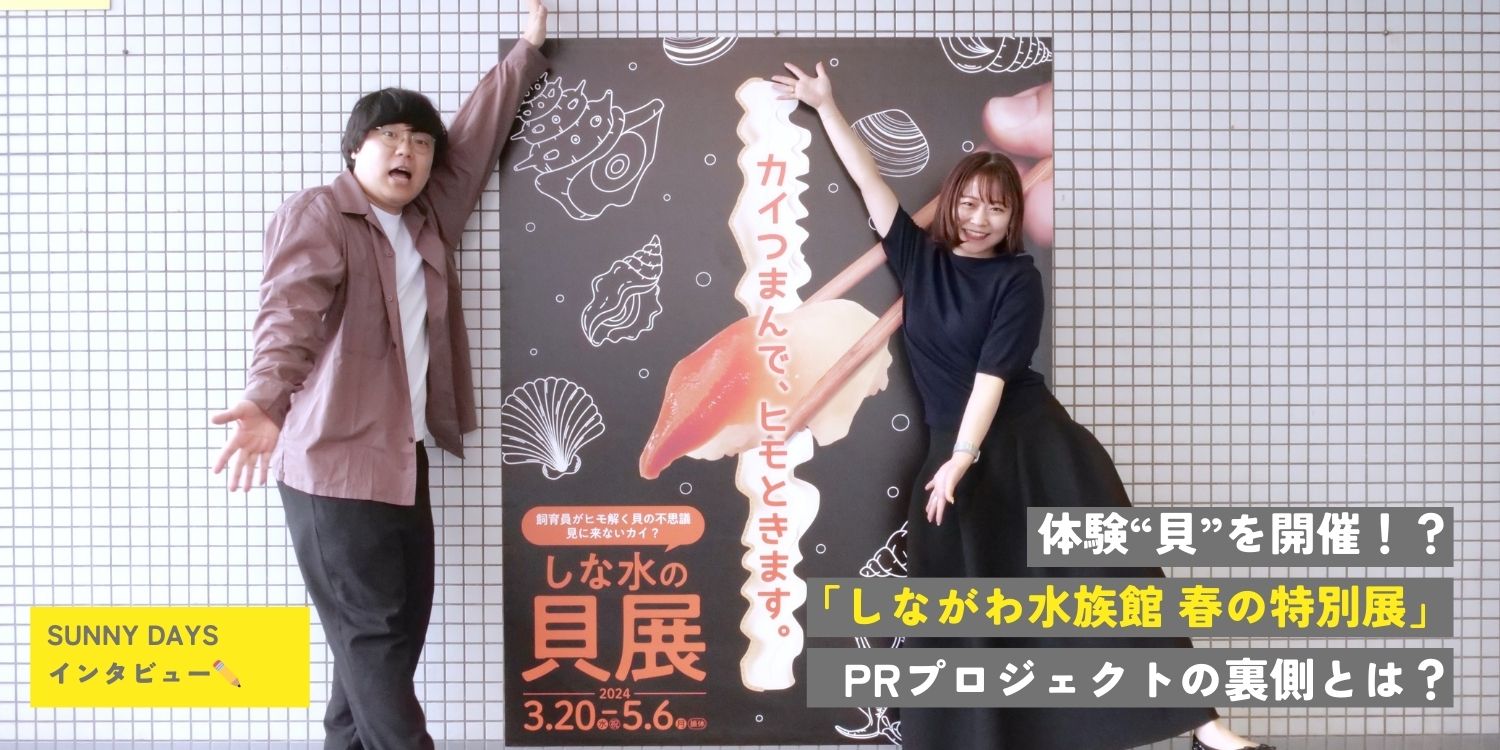
Shinagawa Aquarium in Shinagawa City is currently hosting a special spring exhibition titled “Kai-tsumande, Himo-tokimasu: Shinagawa Aquarium Shellfish Exhibition.”
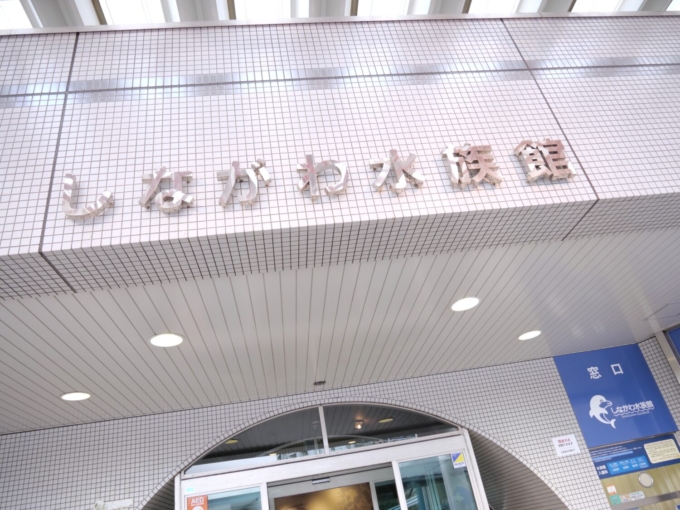
This special exhibition focuses on shellfish—familiar to many, yet still full of little-known appeal. There are plenty of unique features, including Q explanation panels that “pick out” and “unravel” the charm of shellfish, and a “shell (kai) conveyor-belt sushi” corner where shellfish-themed rotating sushi makes an appearance.
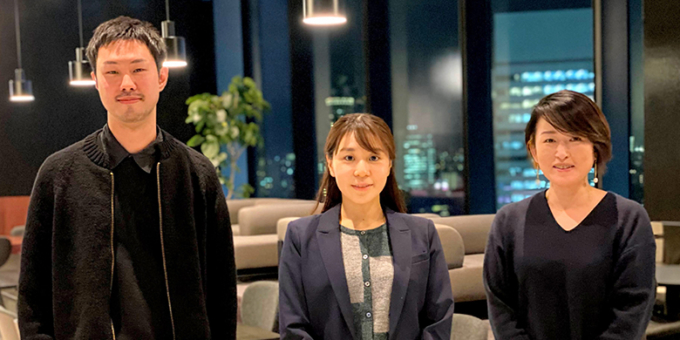
At SUNNY SIDE UP, we were in charge of PR for this exhibition. For this feature, we interviewed Morikawa and Kaneko from SUNNY SIDE UP, who led the project.
While introducing spots where you can truly experience the appeal of Shinagawa Aquarium, they spoke in depth about the exhibition highlights and the key points they focused on in PR.
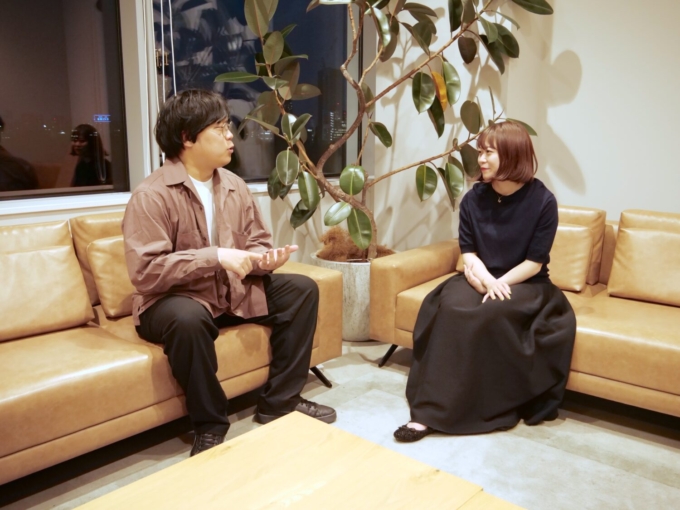
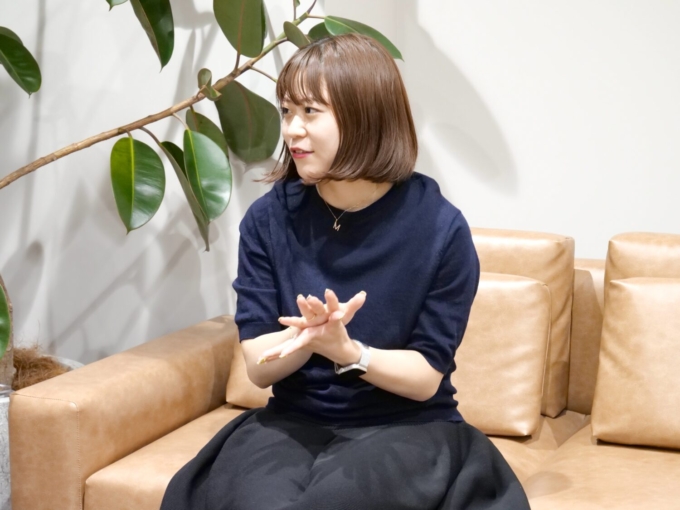
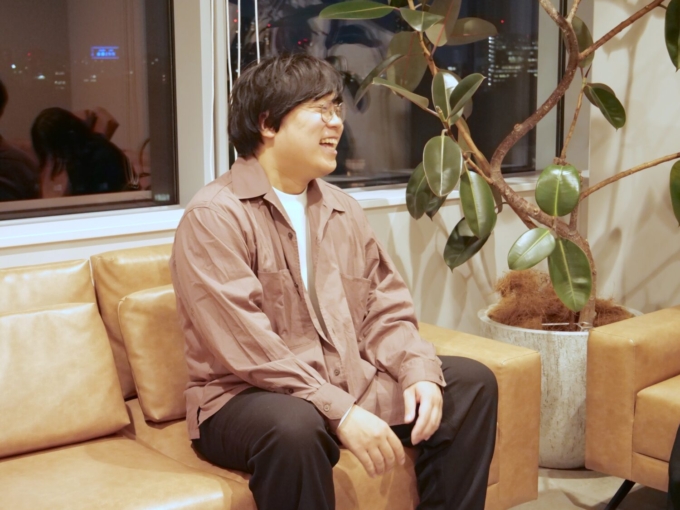
Left: Morikawa Right: Kaneko
In charge of PR for a playful shellfish exhibition
—Please tell us how you came to work with Shinagawa Aquarium.
Morikawa: We received a request from Shinagawa Aquarium to handle PR for the special exhibition, and that is how the project began. The exhibition title, “Kai-tsumande, Himo-tokimasu: Shinagawa Aquarium Shellfish Exhibition,” had already been decided, and my first impression was that it sounded like a fun, playful concept.
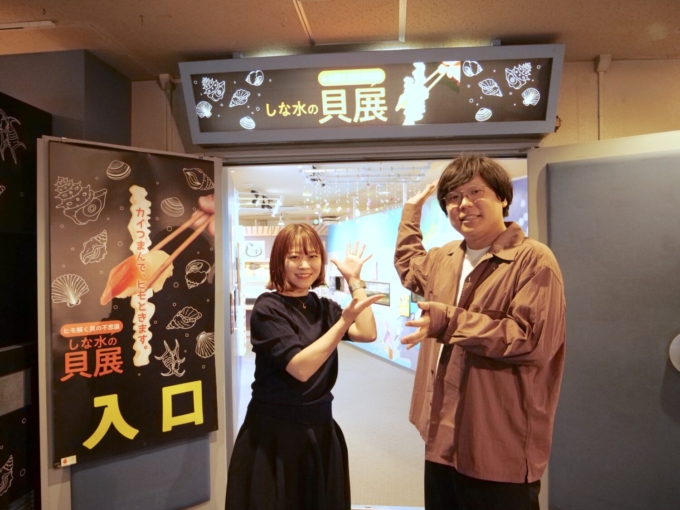
Welcome to the Shinagawa Aquarium Shellfish Exhibition!
Morikawa: Because Shinagawa Aquarium is located in a park surrounded by residential neighborhoods, many local children visit. The facility is designed with many highlights—for example, the tanks are set low so children can easily see the fish, and there is an attraction-like production where the elevator ride down feels like diving into the deep sea.
Kaneko: At first, I was surprised—“Why a shellfish exhibition instead of fish?!” (laughs). But I learned that, as a way to differentiate itself from the typical photogenic “date-spot” aquariums, Shinagawa Aquarium has long hosted interesting niche exhibitions. I felt this was an exhibition that could only be done at Shinagawa Aquarium.
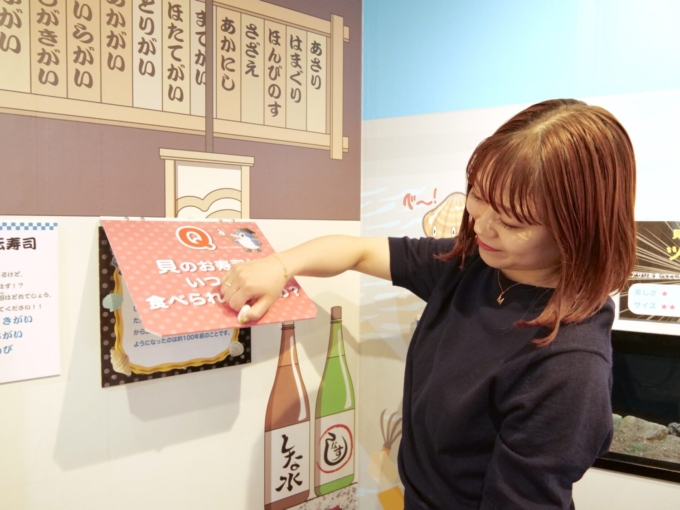
Explanation panels that unravel the appeal of shellfish while “picking out” key points
—Which exhibit particularly captured your interest?
Morikawa: The display of the shells of the flame scallop. It is also called the “rainbow shell,” and there are many colors—some more yellowish, others orange, purple, and more. However, it has not been clarified why they come in so many colors. I found that fascinating and memorable.
Kaneko: There was so much I did not know about shellfish that it was one surprise after another. In particular, the method of extracting pearls left a strong impression on me. I was shocked—“You take it out from there?!” (laughs).
Morikawa: And we were also surprised to learn there are carnivorous shellfish that drill holes into the shells of clams and the like, dissolve them, and eat them. Shinagawa Aquarium has keepers who are truly knowledgeable about shellfish. Almost everything we heard this time was new to us, so it was a constant stream of surprises at how deep the world of shellfish really is.
—How did you approach PR for the exhibition?
Morikawa: The exhibition itself was unique, with a sense of play and learning, but I felt that simply announcing it in the usual way would not stand out to media professionals who receive so much information every day. So we needed to create impact by refining how we presented the exhibition and the experience to the media.
Kaneko: Some members of the media were not familiar with Shinagawa Aquarium. So we thought that by first conveying the appeal of the aquarium itself and then introducing the exhibition, we could deepen their understanding of Shinagawa Aquarium.
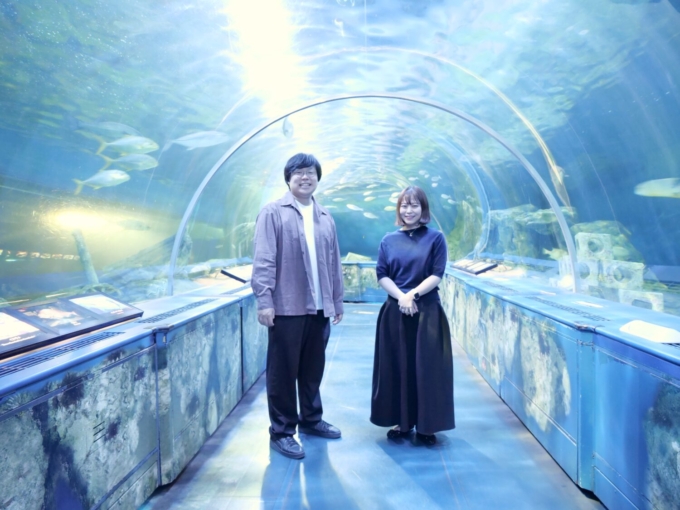
The 22 m-long “Tunnel Tank,” an underwater promenade
Morikawa: There are many panel displays throughout the facility, with lots of thoughtful touches that help visitors learn. For the press day, we designed it so we could communicate not only the exhibition content, but also the interesting points and attention to detail across the entire facility.
High impact: Creating an invitation with wordplay
—What did you do to make the PR for “Kai-tsumande, Himo-tokimasu: Shinagawa Aquarium Shellfish Exhibition” stand out?
Morikawa: First, for the press day, we designed the program so that before explaining the exhibition, participants could learn “What is Shinagawa Aquarium?” For the exhibition explanation as well, we worked with the keepers and had them share shellfish trivia, so that the media could feel the same sense of interest we did.
We also put a lot of thought into the press invitation used to guide media to the press day. For example, in line with the exhibition title, we renamed the press day from the usual “press experience session” to a playful “press experience shell,” and included wordplay such as “You will want to read these ‘shell explanations,’ and we will ‘exhibit shell’ some unusual displays.” By incorporating wordplay to add humor, we believe we created something more memorable for the media. On the day of the “experience shell,” we were happy to hear comments like, “The invitation was fun, too.”
Kaneko: Rather than targeting a specific age group, Shinagawa Aquarium wanted people of all ages to visit. So we took a broad approach in our outreach, contacting media that covers outings as well as women’s media, among others. By tailoring the information to each readership—highlighting content families can enjoy for family-oriented outlets, and sharing photogenic spots for women’s media—we believe we were able to reach a wide audience.
Morikawa: Shinagawa Aquarium was also in the spotlight for the birth of a baby spotted seal in February, so we believe that sharing other highlights beyond the exhibition helped create a synergistic effect as well.
—What kind of response did you receive from the media and visitors?
Morikawa: During the “experience shell” day, the keepers shared shellfish trivia, and their passionate explanations drew audible admiration from the media. We felt it was really resonating.
Kaneko: With the added boost from topics like the birth of the baby spotted seal, we heard that visitor numbers in March increased compared to previous years. It was great to hear that attendance grew to a level second only to August, during summer vacation, which is typically the busiest month of the year.
Morikawa: We also heard that when the aquarium reported on this exhibition to Shinagawa City, they received a very positive response. I was truly happy to hear that.
Creating something people will want to talk about is essential
—What do you keep in mind on a daily basis to deliver PR that moves people?
Morikawa: On my days off, I also go to special exhibitions and shows, and when deciding where to go, my criterion is whether it seems like something that could become a good conversation topic. So when planning PR initiatives, I always keep in mind the importance of creating points that make people want to talk about them.
This time, we added wordplay to the invitation, but I would like to keep trying ideas without being bound by conventional methods—like making documents for the media in an extremely flashy design (laughs). I want to continue creating elements that invite a good “wait, what?” reaction.
Kaneko: When I visit exhibitions or museums as a guest, I hope to gain at least one new insight. This exhibition offers a great deal of knowledge related to shellfish, so visitors are sure to learn something. I would be happy if that sense of interest came through.
—Finally, please share your aspirations going forward.
Morikawa: I have always liked telling people about things I love or think are good. I used to tell my friends, “This comedian is going to make it—check them out” (laughs). That feeling is at the root of why I wanted to work in PR, so I hope to continue doing work that effectively spreads information I want people to know about.
Kaneko: I often get to work on projects I truly want to take on, and I am genuinely grateful for my current environment. I have once again realized how much I like PR work, so I will continue to do my best going forward.
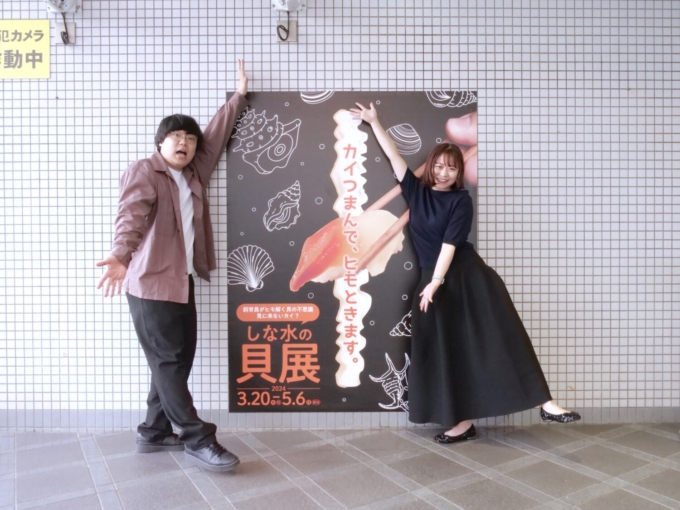
From creating playful invitations that match the exhibition title to other touches woven into the PR initiatives, it is exactly what you would expect from SUNNY SIDE UP—true to our spirit of “Let’s Have Fun!” What kind of “Let’s Have Fun!” will be next?
The “Kai-tsumande, Himo-tokimasu: Shinagawa Aquarium Shellfish Exhibition” at Shinagawa Aquarium will be running until Monday, May 6 (substitute holiday). We hope you will visit.
|
<Event Overview: “Kai-tsumande, Himo-tokimasu: Shinagawa Aquarium Shellfish Exhibition”> Title: Kai-tsumande, Himo-tokimasu: Shinagawa Aquarium Shellfish Exhibition Exhibition webpage: https://www.aquarium.gr.jp/news/events/7908 |